
As an Amazon Associate, I earn from qualifying purchases.
Figuring out infant car seat weight limits can seem tricky, especially with all the changes that babies go through from birth to toddlerhood. Knowing when to switch car seats, and what those weight limits really mean, helps make every family ride safer and way less stressful. I’ll break down what these weight limits mean, why they’re so important, and how to handle the switch as your little one grows.
Understanding Infant Car Seat Weight Limits
Infant car seats are designed with the smallest passengers in mind. Unlike convertible or all-in-one car seats, these are usually rear-facing only and are built for newborns and young babies. Most infant car seats on the market today start at about 4 or 5 lbs., for a newborn, and go up to anywhere between 22 to 35 lbs. for a toddler. The top limit depends on the specific brand and model you choose.
This range means that some babies may reach the weight or height limit faster than others. It’s essential to follow both the manufacturer’s guidance and your state’s safety laws regarding when to switch out the car seat. Always read the car seat label or manual. Using a car seat past its certified limits is not safe and could compromise protection, even in a minor fender bender.
Some babies grow much faster than others. Some fill out and reach the weight limit first. Some shoot up and reach the height limit first. Very few babies reach both the weight and height limit at the same time. Whichever they reach first, it is time for a new car seat.
Weight and Height Limits at Every Stage
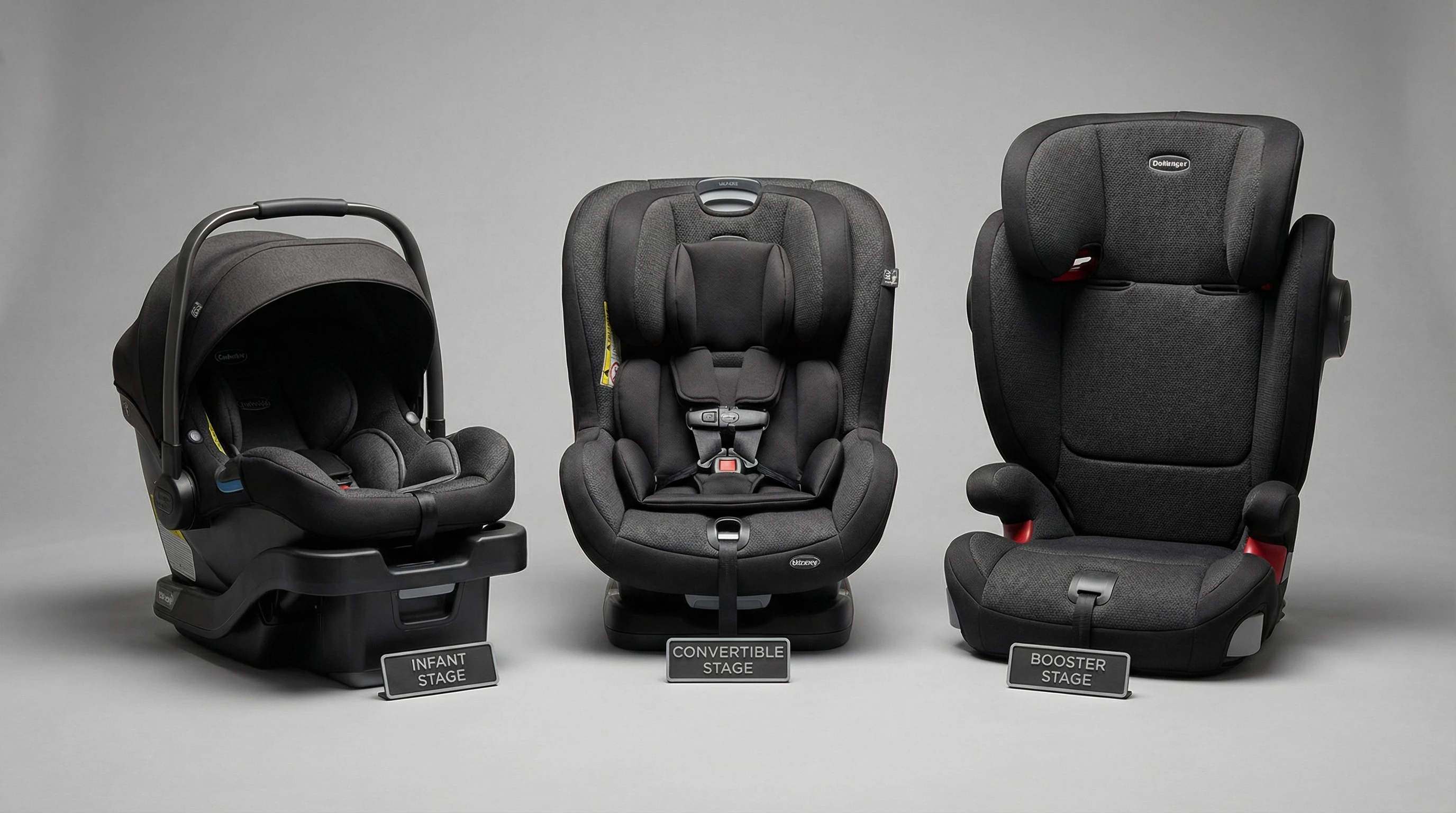
Car seats aren’t one size fits all. Babies and toddlers need different types, each with their own minimum and maximum weight limit. Here’s a straightforward rundown of each stage:
- Infant Car Seats: Typically for babies/toddlers 4 to 35 lbs. and up to 32 inches tall. Perfect for newborns through early toddlerhood
- Convertible Car Seats: They go from rear-facing to forward-facing as children grow. Rear-facing models often cover 5 to 40 lbs., while forward-facing usually maxes out at around 65 lbs.
- All In One Car Seats: Works as a rear-facing infant seat, forward-facing seat, and booster. Rear- facing is often suited up to 40 lbs., sometimes even 50 lbs., depending on the model.
- Booster Seats: For kids who’ve outgrown a harness. The minimum weight limit is 40 lbs,, and the maximum weight limit is between 100 lbs. to 120 lbs., based on the seat manufacturer and local rules.
Height is just as key as weight, because some children stretch up before they pack on the lbs. If your child’s head comes within one inch of the top edge of the car seat’s shell— even if they’re under the weight mark— it’s time for a new seat.
Why Infant Car Seat Weight Limits Matter
Manufacturers establish weight limits because each car seat is crash tested to protect children within those bounds. If your child is over the posted limit, the seat can’t guarantee the same level of safety in a crash. That’s critical in real world situations for your child’s wellbeing.
Outgrowing the seat by weight or height can happen faster than you think. For many babies, especially ones who are tall and slender, height is often reached before weight. Regular check-ins with your child’s measurements ensure you don’t miss the moment to move up to a new car seat.
Popular Infant Car Seat Models and Their Limits
Different car seat brands and models have varied rules. Here’s a snapshot of some popular choices in the U.S., including their weight and height specs:
- Chicco Key Fit 30://amzn.to/49mrTvP For babies weighing 4 to 30 lbs., up to 30 inches tall.
- Graco SnugRide SnugLock LX:https://amzn.to/43dyuoZ Works for infants 4 to 30 lbs., up to 32 inches tall.
- UPPA baby MESA V3:https://amzn.to/4nPIJcj Suitable for 4 to 30 lbs., with a 32 inch height limit.
- Britax BSafe Gen2 has been discontinued! It is being replaced by the Britax Galaxy 360 Slim Rotating Convertible Car Seat:https://amzn.to/4dv5UW2 Suitable for 5 to 50 lbs. rear-facing and 30 to 65 lbs. forward facing. It will be available for sale March 9, 2026!
- Graco Modes Pramette Travel System Car Seat and Stroller Combo:https://amzn.to/3PVJwfnSuitable for rear-facing from 4 lbs. to 35 lbs. and 32 inch height limit.
The numbers are more than trivia. If your baby exceeds either the weight or height maximum, it’s time to transition to the next car seat. Double check the manufacturer’s label, since updates can appear each year.
Moving Up: When and How to Upgrade Car Seats
Moving from an infant seat to something bigger is a significant milestone. You need to switch as soon as your child hits the maximum weight or height listed by the seat’s maker. But you might need to upgrade for other reasons, too.
Rear-facing is the safest position for young children, and most experts (like the American Academy of Pediatrics) say to keep little ones rear facing well past age 2, as long as your seat allows. That’s why many families grab a convertible seat next, which will grow with the child both rear-facing and then forward-facing.
It’s time to change seats if:
- Your baby surpasses the weight or height limit.
- Their head approaches the top edge of the car seat shell.
- Your child looks uncomfortably cramped (but be sure to re-check the seat’s safety parameters).
Convertible and all-in-one seats handle much greater sizes and are designed for the next phases. Some even keep children rear-facing up to 40 or 50 lbs. The right research gives you the confidence to choose the best model for your child’s size and age.
Convertible Car Seats: The Next Stage
When your baby is too big for the infant carrier, it’s time for a convertible seat. These seats go from rear-facing to forward-facing as children grow, making them longer lasting and more practical for many families.
Typical numbers look like this:
- Rear-facing: 5 to 40lbs., sometimes up to 50 lbs.
- Forward-Facing: 22 to 65 lbs,, secured with a five-point harness. Height usually tops out at 49 inches.
Popular convertible seat models include:
- Graco Extend 2 Fit:https://amzn.to/4tQ5WwB Rear-facing 4 to 50 lbs., forward-facing up to 65 lbs.
- Britax One4Life All-in-One:https://amzn.to/4vsnUGL Rear-Facing 5 to 50 lbs., forward-facing up to 65 lbs.
- Maxi-Cozi Pria All-in-One Convertible Car Seat:https://amzn.to/4dHk3xU Rear-facing 5 to 40 lbs., forward-facing up to 49 lbs. and belt-positioning booster 40 to 100 lbs. Height goes from 19″ all the way up to 52 inches.
Children often reach the height restriction before the weight mark. Keep your child rear-facing for as long as possible within those boundaries, as it’s much safer. Squished legs doesn’t mean the seat isn’t safe—if your toddler is still under the weight and height max, the seat is doing its job.
All-In-One and Booster Seats: Growing With Your Child
All-In-One car seats get more popular every year because they suit all ages and stages, from infants up to booster mode. They have a wide range of weight and height limits, making them cost effective through years of growth and car rides.
Standard ranges for these seats:
- Rear-Facing: Usually 5 to 40 or 50 lbs.
- Forward-Facing harness: Up to 65 lbs. and up to 49 inches tall
- Highback booster/backless booster: Usually 100 to 120 lbs., or up to 57 inches tall
Notable All-In-One models:
- Graco 4Ever DLX 4-in-1:https://amzn.to/4v5WlTd Rear-Facing 4 to 40lbs., forward-facing 22 to 65 lbs., high back booster 40 to 100 lbs., and backless booster 40 to 120 lbs. This car seat can be used up to 10 years, from birth to booster!
- Safety 1st Grow and Go:https://amzn.to/4dLZkcA Rear-Facing 5 to 40 lbs., forward-facing 30 to 65 lbs. and 34.4 inches tall to 49 inches tall, booster from 40 lbs., to 100 lbs. and 43.4 inches tall to 52 inches tall.
- Diono Radian 3RXT: Rear-Facing 5 to 50 lbs., forward-facing 22 to 65 lbs., booster up to 120 lbs. This carseat is currently unavailable. I am waiting for them to make it available. However, if you are looking for a high back booster for older children, check out the Diono Connect 3 RXT. It is a 2 in 1 high back booster. It is good for children weighing between 40 lbs. and 120 lbs.
Though these seats fit many ages, always follow the height and weight rules when switching to the next model. Don’t put a child in booster mode until they’ve outgrown the harness, are at least 40 pounds, and can sit upright properly for every car ride.
Common Mistakes With Car Seat Weight Limits and How to Avoid Them
I’ve seen several mistakes with car seat choices—usually because the labels seem overwhelming with information. Here are a few common mis-steps to keep in mind and avoid:
- Forgetting about height restrictions: Some children get tall fast. Check both their weight and height often.
- Using an old or expired seat: Hand Me Downs can be risky, as built-in safety features change over time and materials wear out. Always double-check for height and weight restrictions and expiration dates.
- Switching seats too early: Some parents move up before their child technically needs to. As long as your child fits within the current seat’s bounds, it’s safest to keep them there.
- Harness adjustment errors: Children outgrow harness settings as they grow. For rear-facing seats, straps should come from just below or level with the shoulders; for forward-facing, make sure they’re at shoulder height or slightly higher.
Routinely checking your child’s fit in the seat can catch any surprises. Try setting a reminder on your phone for every few months, or check each time you visit the pediatrician for updated height and weight stats.
How to Check if Your Car Seat Is Properly Installed
The safest car seat only keeps your child protected if it’s installed properly. More than half of all car seats are installed incorrectly in some way. Here’s a practical quick list for checking your installation:
- Read both instructions—the car seat and the vehicle manual—to get the specifics.
- After installation, the seat should only move less than an inch side-to-side at the belt path.
- Check the level. For infant and convertible models, make sure the base is even with the ground. Many come with built-in bubble levels for ease.
- For rear-facing seats, ensure the harness is snug and can’t be pinched at the shoulder.
- The chest clip needs to sit at armpit level, every time.
- Register new car seats with the manufacturer to receive safety recalls or updates.
- If you’re unsure, attend a car seat check or see a safety technician. For more information check out Finding A Car Seat Technician for personal help.
Each car seat and car may have their own quirks, but as long as you follow the directions and meet all the key safety checkpoints, you’re doing it right.
Real Life Example: Growing Through Car Seats
When my nephew outgrew his infant seat at about 9 months, it wasn’t that he had surpassed the weight max—he only weighed a bit more than 20 pounds—but his height shot past the seat’s guide and he had less than an inch left between the crown of his head and the shell. Even though he wasn’t too heavy, our family moved him into a rear-facing convertible seat, which ended up keeping him rear-facing until almost 3 years old. Seeing this up close made me realize how quickly those measurements can catch families by surprise.
How to Choose the Right Car Seat for Your Baby’s Size and Age
With so many numbers to keep track of, picking which car seat to buy isn’t as simple as grabbing the next size up. The ideal seat matches your child’s current measurements, fits your car, and works for your travel lifestyle.
Ask yourself these questions while shopping:
- What are your child’s latest height and weight, and are they growing rapidly?
- Do you want to stretch out rear-facing use as much as possible?
- Will you need to move the seat between different cars a lot? (Infant carriers are lighter, while convertible or all-in-one seats can be heavier and harder to swap.)
- How roomy is your car for various seat types?
- Are you juggling space with other children or other car seats in your vehicle?
If you’re uncertain, bring your child and the seat to the store, or double-check with customer support for a good fit. You can even contact a car seat specialist .There’s no “best” car seat that fits all, but the safest one is the car seat you use the right way, every ride.
Frequently Asked Questions About Car Seat Weight Limits
Parents ask a lot of questions (and have valid concerns) about proper car seat use. Here are some of the most common questions I hear:
What if my child hits the height limit first?
Move up to the next seat, even if they’re still under the weight cap. Proper head position is vital for crash safety, not just the number on the scale.
How do I know if my baby has outgrown their seat?
Check the seat label for weight and height specs. If your child’s shoulders are above the top harness slot, if there’s less than an inch from the top of their head to the edge of the seat, or if their weight is over the posted number, it’s time for the next stage.
Is it less risky to keep my child in rear-facing mode even if they pass the specified limits?
No. Once your child is at or over either the height or weight limit for rear-facing, you need to move up to a seat that can fit them—preferably still rear-facing if possible.
Can an infant car seat be used for premature or tiny babies?
Plenty of infant car seats are tested for babies as little as 4 lbs. with extra support pads or inserts included. Double-check the seat label and ask your pediatrician, if your baby is under 5 lbs., for peace of mind.
Wrapping Up: Keeping Your Child Safe at Every Stage
Car seat safety is always changing as your child grows, but knowing and respecting the weight and height rules for each stage makes every adventure less stressful. Always use the right seat for your babys/childs current size, don’t delay upgrading once limits are hit, and get expert guidance if needed. Attention to these details means safer rides for every trip, whether you’re running errands or heading on a cross-country road trip. Our children are our most precious jewels, and they deserve to be protected at all costs.