Your 13-month-old at a glance
At 13 months, most babies are moving from the baby stage toward early toddlerhood. The changes are uneven. One child walks across the living room while another is happy cruising along the couch, and both can be well within the typical range.
Here is a quick summary for busy days:
- Movement: Pulling to stand and cruising along furniture are common. Independent steps are common too, but many children do not walk until later in the second year.
- Hands: Picking up small foods between thumb and finger, banging blocks together, and putting objects into containers.
- Language: A few words, such as “mama,” “dada” or “ball,” plus gestures like waving and pointing. Understanding runs well ahead of speaking.
- Emotions: Strong attachment to familiar adults, and often more protest at separations.
- Sleep: Around 11 to 14 hours in a 24-hour day, including naps, is the range commonly given for ages one to two. Many 13-month-olds still take two naps.
- Food: Whole cow’s milk (or continued breast milk) alongside three meals and a couple of snacks of family foods cut to a safe size.
Milestones are ranges. A child who is a little early in one area and a little late in another is common, and the sections below say plainly which signs are worth raising with a pediatrician.
Walking, cruising and climbing: gross motor skills at 13 months
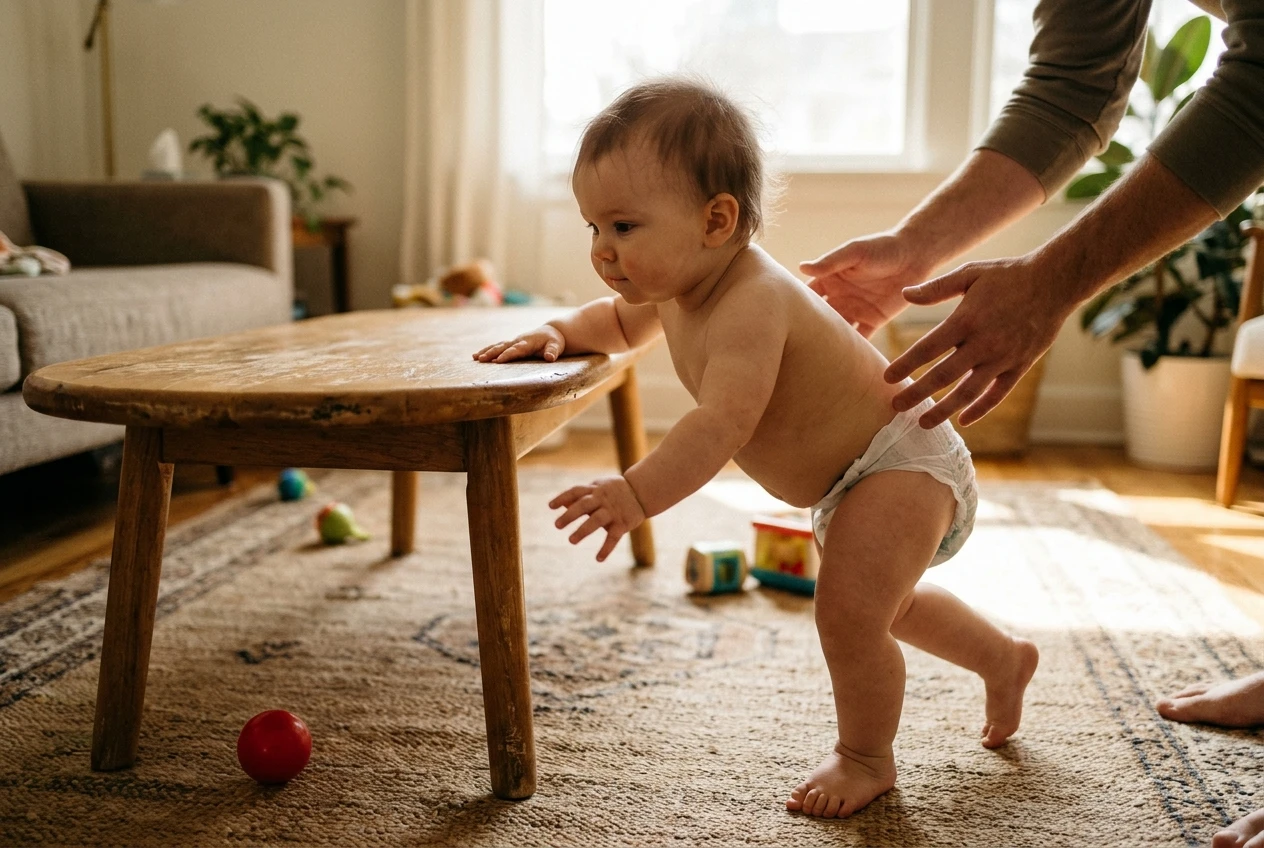
Gross motor skills are the big movements: sitting, crawling, standing, walking and climbing. At 13 months, children are at very different points. Some are still crawling quickly and pulling up on everything. Some cruise sideways along the sofa. Some take a few unsupported steps, and a few are already walking with confidence.
Walking is usually described across a wide window, from roughly 9 to 18 months, and most children are walking by about 18 months. A 13-month-old who is not walking yet is not behind by default. What matters more is that the child is working toward it: pulling to stand, cruising, bearing weight on both legs, and wanting to move.
How to support walking
- Let them go barefoot indoors. Bare feet give the most feedback from the floor and help balance. Shoes are mainly for protecting feet outside.
- Clear a safe path. Furniture that slides, low tables with sharp corners, and rugs that bunch up are the usual problems for new walkers.
- Offer a low, stable support. A sturdy low table or a couch at chest height works well for cruising. Push toys can help some children, but choose a heavy, stable one that will not run away from them.
- Resist holding both hands and walking them around. It tends to bend a child forward and does little to build their own balance. Holding one hand or standing a short distance away with your arms out works better.
Falls are part of learning. Soft landings help: pad corners if you like, keep hard toys off the floor in walking areas, and stay close when they climb.
Climbing
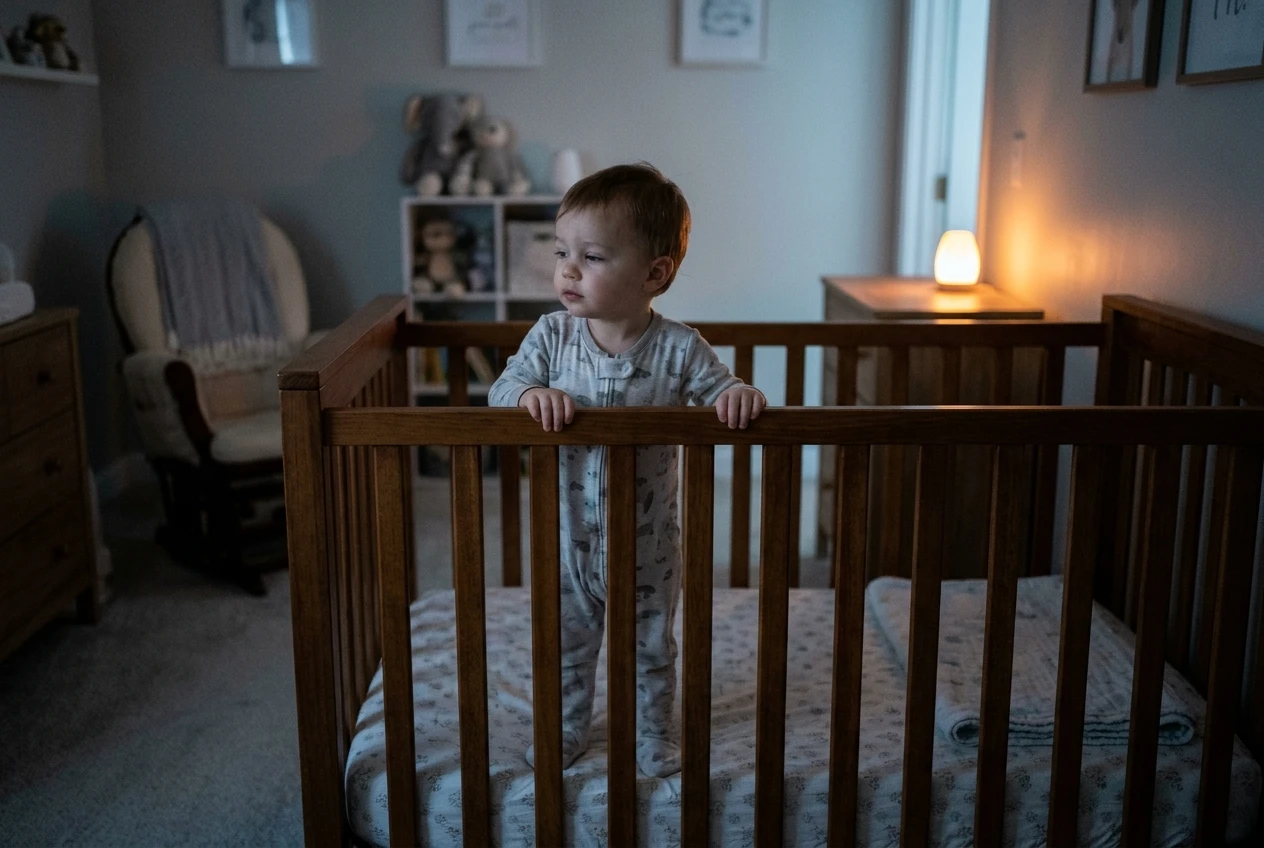
Many 13-month-olds start climbing onto low sofas, stairs and anything else with a ledge. This is normal, and it also means it is time to check the home. Anchor bookcases and dressers to the wall, use stair gates at the top and bottom of stairs, and lower the crib mattress to its lowest setting if your child can pull up on the rail. Learning to climb safely is easier with a supervised, designated spot, such as a low cushion or a few steps with you close behind.
Pincer grasp, stacking and scribbling: fine motor skills
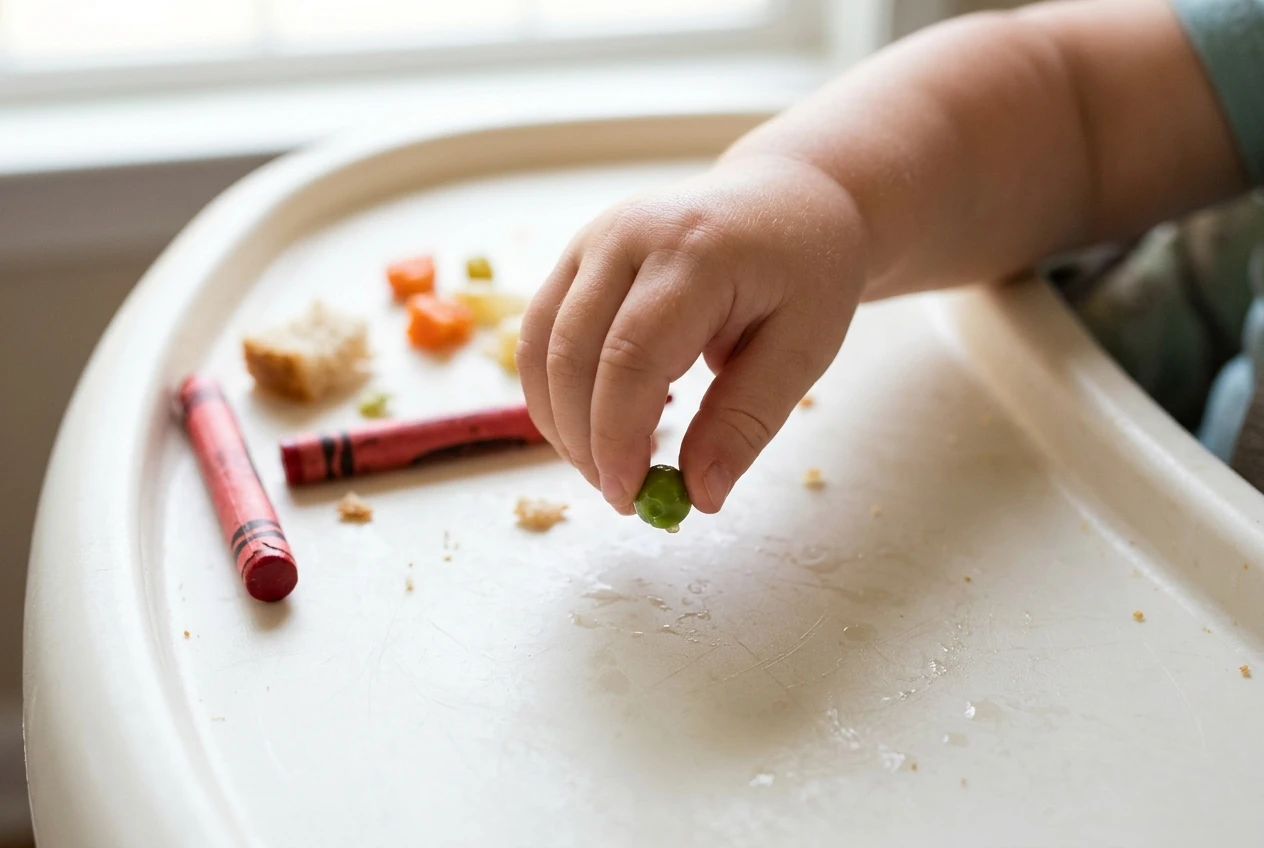
Fine motor skills use the small muscles of the hands and fingers. By 13 months, most babies have developed or are developing a pincer grasp, which means picking up a small item between the tips of the thumb and index finger. It often appears between 9 and 12 months, so if yours is still using a raking motion with the whole hand, practice is all it needs unless you see other concerns.
Things you may see at this age:
- Picking up cereal pieces, peas or soft bits of food and getting them to the mouth.
- Banging two toys together or dropping objects deliberately to watch what happens.
- Putting items into a container and taking them out again, over and over.
- Holding a crayon in a fist and making marks on paper.
- Trying to stack two blocks, which many children manage closer to 15 to 18 months. Knocking your tower down is more typical at this age.
- Turning the thick pages of a board book, often several at a time.
- Pointing at things with the index finger.
Repetition is how this works. A 13-month-old who empties the same basket twenty times a day is practicing grasp, release and the idea that objects keep existing when out of sight.
If a child uses only one hand consistently and seems unable to use the other, or does not bring objects to the mouth or hold things at all, mention it to the pediatrician. An early preference for one hand is something doctors often watch at this age because handedness usually settles later.
First words, gestures and understanding: language and communication
A 13-month-old understands far more than they can say. Typical communication at this age includes:
- A few words with meaning, such as “mama” or “dada” for the right person, “ball,” “dog” or “uh-oh.”
- Babbling that sounds like sentences, with changes in tone.
- Waving bye-bye, shaking the head, reaching up to be lifted, and pointing to show you something or to ask for it.
- Responding to their name and to simple requests like “come here” or “give me the cup,” especially with a gesture.
- Looking toward a familiar object when you name it, such as a dog or a spoon.
Some children have a handful of words at 13 months and some have none yet. Gestures and understanding count as language, and they are better predictors of progress than the exact word count. A child who points, waves, follows simple directions, babbles back and forth with you, and tries to get your attention is communicating.
Ways to build language day to day
- Narrate ordinary moments. “Now we put on your socks. One sock, two socks.” Short sentences with the key word at the end are easy to pick up.
- Pause and wait. After you ask a question or offer two choices, give a few seconds for a sound, a look or a point.
- Name what they point at. If they point at the dog, say “Yes, a dog. The dog is big.” This turns a gesture into a word.
- Expand their attempts. If they say “ba,” you can say “Ball! A red ball.”
- Read daily. Board books with clear pictures and few words work best. Let them hold the book, turn the pages and point. You do not need to read the text as written.
- Limit background noise. A TV running all day makes it harder for a child to hear the speech directed at them.
Babies from bilingual homes may mix languages or have fewer words in each language, but their total vocabulary across both is usually typical.
Feelings, clinginess and independence: social and emotional growth
Thirteen months is a time of mixed signals. Your child wants to explore, but also wants you in sight. Separation anxiety often peaks somewhere between about 10 and 18 months, so crying at drop-offs or following you from room to room is common.
You will probably see:
- Clear preference for familiar people, and wariness or tears with unfamiliar ones.
- Handing you a book or toy, then taking it back, as an early form of turn-taking.
- Copying what you do: pretending to drink from a cup, talking on a toy phone, brushing their hair.
- Showing affection with hugs, kisses (open-mouthed and drooly) and cuddling a stuffed toy.
- Early frustration. They know what they want but cannot say it or do it yet, which can lead to whining, flinging food, or a short tantrum.
- Testing limits, such as dropping a spoon to see whether you will pick it up.
Real-talk tip for this month
Many parents at this stage are tired from some combination of teething, disrupted sleep, a child who needs to be near them constantly, and a toddler who has just discovered “no.” First molars commonly come in between about 13 and 19 months, and they can cause drooling, chewing on everything, crankiness, and wakeful nights.
For teething, a cold (not frozen) teething ring, a chilled clean washcloth, or firm, safe food for chewing under supervision can help. Avoid amber necklaces and teething gels containing benzocaine, which health authorities have warned against for young children. Ask your pediatrician which pain relief, if any, is suitable for your child.
For clinginess, a brief and predictable goodbye works better than sneaking away. Say goodbye, tell them who is staying with them and when you will be back, and leave. Most children settle within minutes after the parent is gone. A phase of intense attachment does not mean you are doing anything wrong.
Sleep at 13 months: night sleep, naps and common regressions
Most children between one and two years of age need about 11 to 14 hours of sleep per 24 hours, including naps. At 13 months that often looks like 10 to 12 hours at night and one to two daytime naps. Individual needs vary, so look at how your child behaves during the day, not just the numbers.
Wake windows
Many 13-month-olds do well with roughly three to four hours between the end of one sleep and the start of the next. If your child takes two naps, the first is often mid-morning and the second early afternoon. These are rough guides, not rules. A child who is cheerful and falls asleep easily at the current times does not need a schedule change.
The two-to-one nap question
The shift from two naps to one commonly happens somewhere between 12 and 18 months, so a 13-month-old is on the early side. Most children at this age still do better with two naps. Signs that your child may be ready to drop one include:
- Consistently refusing the second nap for a couple of weeks, not just one or two days.
- Taking a long time to fall asleep at one of the naps even when tired.
- Waking very early in the morning, or at night, after previously sleeping well, because the daytime sleep is now too much.
If you do move to one nap, it usually sits around midday and lasts one to three hours. For a few weeks, an earlier bedtime can cover the gap. Expect a bumpy transition and some short or skipped naps. Going back to two naps for a few days on rough days is fine.
Regressions and disruptions
Sleep often gets worse around this age. Common causes are:
- New motor skills. Children practice pulling up and walking in the crib at 3 a.m.
- Teething. Molars can interrupt sleep for several nights at a time.
- Separation anxiety. Your child wakes and wants to be sure you are there.
- Illness. Colds and ear infections are common in this age group.
- Schedule changes. Travel, a new daycare, or an early dropped nap.
These disruptions usually pass in a few days to a couple of weeks. Keep the bedtime routine consistent, respond calmly and briefly at night, and avoid starting new habits you are not happy to continue. If sleep has changed suddenly and your child also seems unwell, has a fever, or is pulling at an ear, call the pediatrician.
For safe sleep, use a firm, flat crib mattress with a fitted sheet. Many guidelines say a small, thin blanket can be introduced after 12 months. Check with your pediatrician, and keep large pillows, bumpers and stuffed toys that could be used to climb out of the crib.
Feeding a 13-month-old: whole milk, table foods and picky phases
Milk
After the first birthday, whole cow’s milk can replace formula, and breast milk can continue for as long as you and your child want. A commonly cited amount of whole milk for toddlers is about 2 to 3 cups (16 to 24 ounces) per day. More than that can fill your child up so they eat less food, and too much cow’s milk can contribute to low iron. Your pediatrician can tell you what suits your child.
If your family avoids dairy, ask your pediatrician about alternatives. Not all plant milks have the protein, fat and calories that toddlers need, and some are low in nutrients compared with cow’s milk. Fortified unsweetened soy milk is the one most often discussed for this age, but the doctor should guide the decision.
Many families also use this period to move from bottles to cups. Pediatric groups generally suggest moving away from bottles between 12 and 18 months. An open cup or a straw cup is a good place to start, and a small amount of water with meals is fine. Juice is not needed. If you offer it, pediatric guidance limits it to a small amount a day.
Table foods
A 13-month-old can eat most of what the family eats, with changes to texture and size. Aim for about three meals and two or three snacks a day, with a mix of:
- Iron-rich foods such as meat, beans, lentils, eggs and iron-fortified cereal.
- Vegetables and fruit, cooked soft or cut small.
- Whole grains, such as oatmeal, pasta, rice and toast strips.
- Dairy, such as yogurt and cheese.
- Healthy fats, such as avocado, nut butters spread thinly, and olive oil in cooking.
Honey is considered safe after 12 months. Keep salt and added sugar low, and keep offering the common allergens regularly if they have been introduced already.
Choking safety
Toddlers are still learning to chew. Foods that commonly cause choking include whole grapes, whole nuts, popcorn, hard raw vegetables like carrot sticks, hard candy, chunks of meat or cheese, and round slices of hot dog. Cut grapes and cherry tomatoes lengthwise into quarters, shred or finely chop meat, and cook hard vegetables until soft. Always have your child sit while eating and stay with them.
It is worth taking an infant and child first aid and choking-response course from a recognized provider, so you know what to do before you need it. Reading about it is not the same as practicing the techniques.
Picky phases
Appetite often drops after the first birthday, because growth slows. A toddler may eat a lot one day and very little the next. It is also common for a child to refuse a food they ate last week. This does not mean they dislike it for good. Children often need to see and taste a new food many times before accepting it.
A division of responsibility helps many families: you decide what food is offered, when and where, and your child decides whether to eat it and how much. Put a small amount of a new food next to something familiar, eat it yourself, and avoid pressure, bribes or commenting on how much they ate.
Feeding gear
If you are choosing gear, these are the practical considerations:
- High chair: Look for a stable base, a footrest (feet that dangle make sitting harder), a harness, and a tray or surface that wipes clean easily.
- Suction plates and bowls: Helpful for children who tip plates over, though some will learn to pull them off. A plate with a firm base works better for many.
- Utensils: Short, wide-handled spoons and forks with rounded tips suit small hands. Letting your toddler hold their own spoon, even if most food ends up elsewhere, builds skill.
- Cups: Open cups, small cups with two handles, and straw cups all work, so you can try a few to see what your child prefers.
Play ideas that build skills at 13 months
Toddlers learn best through everyday play with a caregiver nearby. You do not need many toys. A few well-chosen items and your attention are enough.
Game 1: In and out
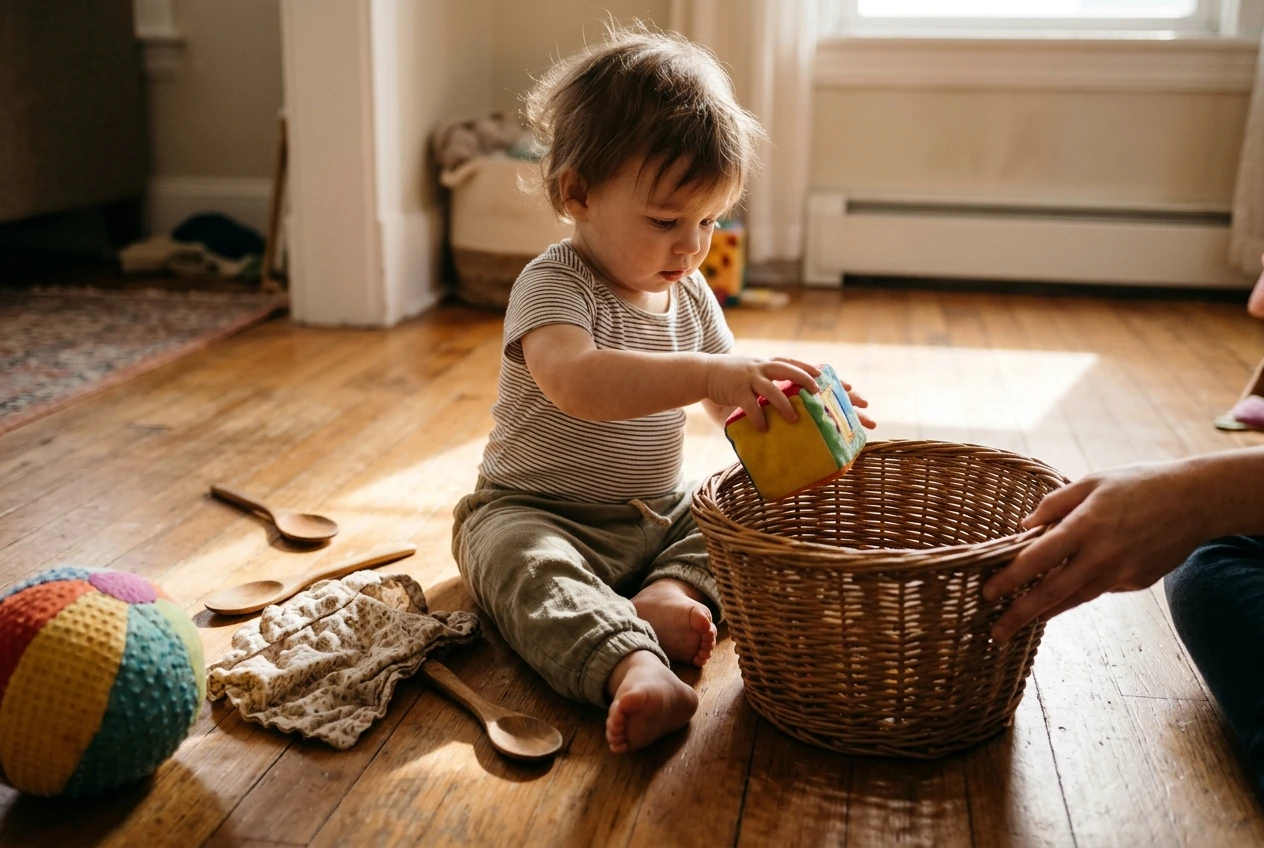
Give your child a basket or box and a handful of safe objects, such as soft blocks, wooden spoons, large balls and cloth scraps. Show them how to put things in and take them out, naming as you go: “In. Out. The ball is in the box.” This practices release, hand-eye coordination and early vocabulary. Make it a bit harder by using a container with a smaller opening.
Game 2: Peekaboo and hide-and-find
Hide a toy under a cloth while your child watches, then ask “Where did it go?” Pause, let them pull the cloth off, and celebrate. Searching for hidden objects builds object permanence and memory. As they get better, hide the toy under one of two cloths.
Game 3: Cruising course
Line up sturdy furniture or couch cushions so your child can cruise along them toward a favorite toy. Set the toy slightly out of reach so they need to shuffle along to get it. You can also put a few soft cushions on the floor to climb over, with you right beside them. This supports balance, strength and confidence.
Toys worth considering
- Board books and mini books: Pick up books with real photographs or clear drawings of familiar things, such as animals, faces and foods.
- Wooden pull-toys and push toys: Sturdy ones help with early walking and give something to chase.
- Stacking cups and chunky blocks: Good for stacking, nesting and knocking down.
- Sensory items: Textured balls, fabric books, and safe containers with something that rattles inside them. Check that anything with small parts cannot come apart.
- Simple musical toys: Shakers, a small drum, or a pot and wooden spoon, which are as satisfying as a bought toy.
Before you buy any toy, check the age label, look for small or detachable parts, and test that it can take being thrown, chewed and dropped. Outdoor time matters too. A walk, a patch of grass, or a playground baby swing gives your child new things to see, touch and name.
When to call the pediatrician: signs worth raising at this age
Most differences at this age are normal variation. Regular well-child visits are the best time to ask about development, and your pediatrician will use a screening tool to check progress at set ages. You can also raise a concern between visits. Trust your sense that something is different, because you know your child best.
Talk to your pediatrician soon if your child:
- Is not pulling to stand or bearing weight on their legs when held upright, or seems stiff or floppy.
- Is not crawling or moving in any way to get around, or drags one side of the body.
- Does not use gestures such as waving, pointing, or reaching to be picked up.
- Does not babble or make varied sounds, or does not respond to their name or to familiar sounds.
- Does not look for objects you hide in front of them.
- Avoids eye contact or rarely smiles and interacts with people.
- Has lost skills they previously had, such as babbling, smiling or moving. Loss of skills at any age should be checked promptly.
- Has trouble feeding, gags or chokes often, or is growing slowly.
Get urgent help for difficulty breathing, a seizure, a fever with unusual sleepiness or poor response, a stiff neck, or any choking episode that does not clear.
If your child is a little behind in one area but progressing, your doctor may suggest waiting and watching. If there are real concerns, early intervention services can evaluate children from birth, and in many places you can request an evaluation yourself without a doctor’s referral. Starting early is helpful, and an evaluation that finds nothing wrong is still worth having.
This guide gives general information and does not replace medical advice for your child.
What to look forward to at 14 months
Over the next month, you may see more confident walking and a growing desire to climb, carry things and push furniture. Language usually keeps expanding, with more consistent words and a clearer sense of what your child understands. Many toddlers begin to point to body parts, imitate more of what you do, and try to feed themselves with a spoon.
Expect sleep and mood to keep shifting with new skills and teeth. Some children begin to show stronger preferences and say “no” more often, which is a sign of growing independence. Keep offering varied foods, reading together, and giving safe places to explore.
If you want to look back at the earlier stage, the previous month’s guide covers the build-up to the first birthday, including the first steps toward standing and cruising and the move toward solid foods. When you are ready to look ahead, the next month’s guide picks up with walking skills, more words and the daily routines of a 14-month-old.