
“A quick note: This post contains affiliate links. If you make a purchase through them, I may earn a small commission at no extra cost to you. I only review products I genuinely trust!”
1. The 37-Year Closet: A Layout Built to Last a Lifetime
When I was preparing the nursery for our son in the 1980s, I faced a common but daunting architectural challenge. He was moving into a wonderful, spacious bedroom, but it featured a massive closet hidden behind double sliding glass doors.
As an interior designer, my instincts kicked in immediately. I knew that standard wire rods and a single shelf weren’t going to cut it for a space that wide or for infant clothing organization! I ended up designing a custom layout using open shelving and pull-out wire baskets, which was manufactured and installed by a specialized closet company. At the time, it was the absolute height of functional innovation.
I knew it was a smart layout, but I never could have predicted its longevity. That closet system stayed in that house for 37 years. It served our son flawlessly from the day we put him in that room at 5 months old, and loaded up the baskets with all his teeny, tiny onesies, diapers, booties, blankets and outfits, through the teenage years of sports gear, all the way until he left home as a grown man at age 27. When we finally sold that house 10 years later, my original organizational unit was still standing, as functional as the day it was built.
While nursery aesthetics and design trends have completely transformed over the last forty years, the core rules of spatial planning have not changed one bit. Whether you are prepping a nursery today or back in 1986, a wide double-door closet requires high visibility, smart zoning, and effortless accessibility. Here is how to take those timeless design principles and replicate a lifetime closet using modern, gorgeous pieces.
2. The Power of the “Slide-Out” (From Industrial Wire to Timeless Texture)
When you are designing a closet for a baby, the biggest mistake you can make is relying entirely on deep, flat, open shelves.
Think about the inventory: babies have tiny clothes, dozens of swaddles, stacks of receiving blankets, and an endless array of loose accessories like socks, hats, and mittens. If you pile these items onto a deep shelf, the things in the front get used, while everything else gets pushed to the back, hidden in the shadows, and outgrown before you even remember you own it.
To solve this, you need the power of the “slide-out.” Pull-out containers act exactly like drawers, allowing you to pull the entire contents of a shelf into the light so you have instant, top-down visibility.
Back in the 1980s, the only way to get that slide-out visibility and crucial fabric airflow was to use industrial-style wire baskets. They worked beautifully, but let’s be honest—they looked a bit cold and utilitarian.
Today’s parents have it so much better. You can achieve that exact same deep, accessible sliding functionality while adding warmth, texture, and a high-end luxury feel to the room.
The Modern Designer Upgrades:
Instead of industrial metal, I love sourcing pieces from Pottery Barn. In our Pottery Barn Kids Storage Collection review, we found that adding soft textures makes a space feel instantly cozier and brings a space to life. A perfect example is the Boucle Basket. Use either of the bins listed in the Cameron Storage Collection.
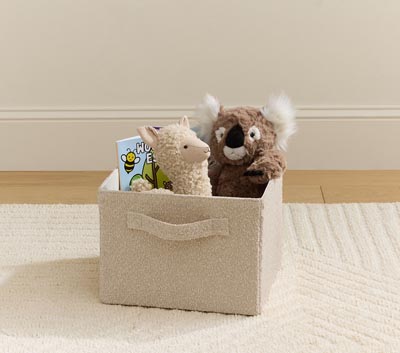
- These bins are plush boucle, lined in canvas. Each has a handle strap on the front for easy grabbing. They give you the heavy-duty durability of a traditional drawer but bring a gorgeous, organic texture into an open closet system. The canvas fabric on the inside is perfect for delicate baby clothes. Bins measure 13″w X 12″d X 10″h.
- The Cameron Woven Utility Bins:
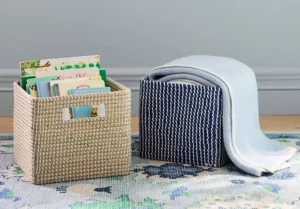
- If you prefer a crisp, woven basket look, these handmade Seagrass and PE Wicker bins are exceptional. They give you the heavy-duty durability of a traditional drawer but bring gorgeous, organic texture into an open closet system. They are perfect for grouping items by category—like “0-3 Month Sleepers” or “Socks & Booties”—and with a cutout handle on each side, it makes it easy to grab one. Bins measure 13″w X 12″d X 10.25″h.
3. Zoning a Massive Space (Overcoming the Blind Spots)
A wide closet is a beautiful luxury in a nursery, but it presents a unique spatial challenge—especially if it features double sliding doors. Because sliding doors cannot open all the way at once, one half of your closet is always hidden from view. This creates immediate “blind spots” right behind the door tracks.
As a designer, my rule for wide closets is simple: Zone by accessibility.
You want to keep your high-visibility center zones dedicated to everyday clothing hanging on rods. This lets you slide a door open and instantly grab a fresh onesie or outfit without digging.
The deeper, harder-to-reach sides behind the door tracks should be zoned for structured storage. This is where you place items you only need to access once a week or once a month: next-size-up clothing bundles, extra boxes of diapers, and heavy seasonal blankets.
Back in the 1980s, I had to hire a custom construction company to build a permanent framework to fit these exact zones. Today, you don’t need a contractor or a massive budget to get a built-in architectural look.
The Modular Solution:
You can build a fully customized, professional framework using the Pottery Barn Kids Cameron Modular Storage System.
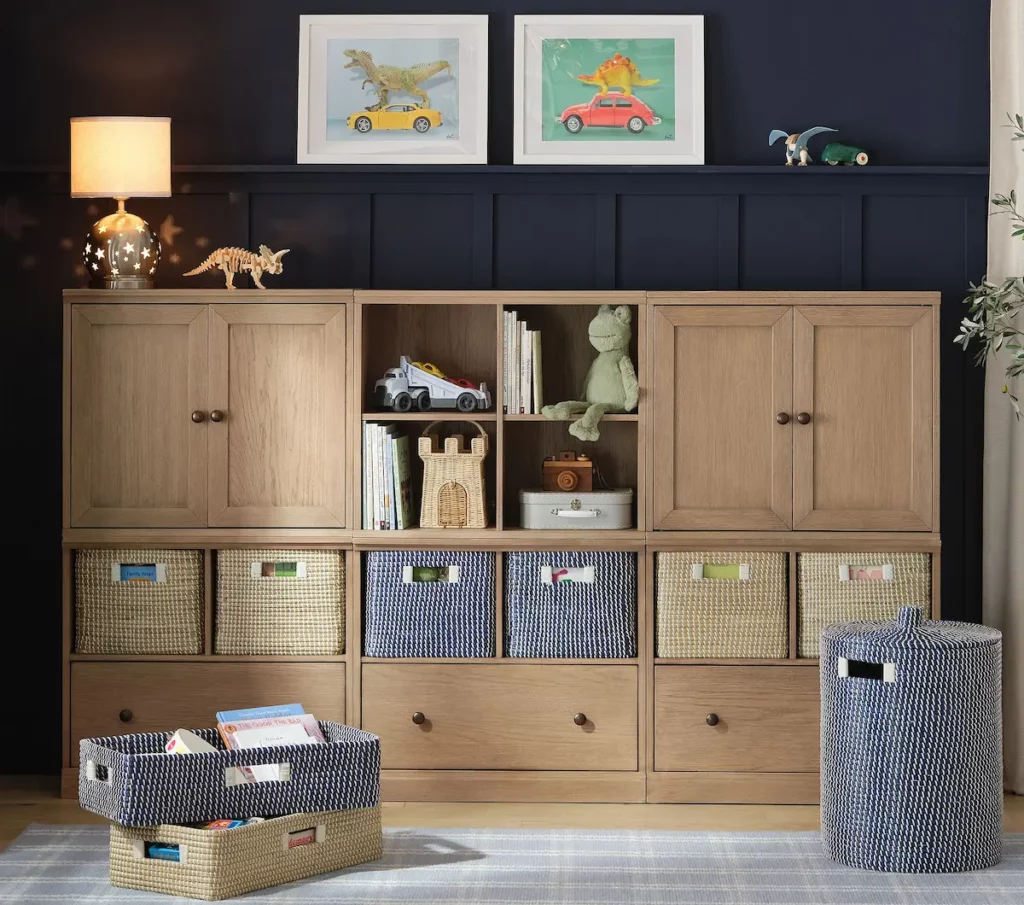
- The Power of Modularity: The Cameron line features interchangeable pieces like open cubby bases, storage cabinets with doors, and drawer units.
- The Design Strategy: For a wide closet, I love placing a heavy-duty storage tower on the far-left and far-right sides of the back wall, leaving the center completely free for adjustable hanging rods right where the doors meet. If you have a massive closet, the Cameron 2-Cubby & 2-Drawer Wide Wall System creates a gorgeous, substantial look. However, to maximize standard closets safely, you can tuck a narrower unit into the hidden side corners and turn them sideways to face the center. The Charlie Bookshelf Tower is a perfect 16-inch deep alternative for this layout. It allows you to stack storage baskets in the dead space without blocking your hanging rods, and mixing a Navy or Seadrift tower with White components creates a stunning, custom-carpentered look.
4. The Non-Negotiable Rules of Nursery Safety: Why Wall Anchoring Saved My Peace of Mind
As an interior designer, I love talking about fabric textures, color coordination, and flawless spatial layouts. But as a mother who went through a terrifying, blood-curdling emergency room ordeal, I need to look you in the eye and give you the single most important rule of nursery design: Safety must always dictate style.When you are looking at a beautifully staged photo of a nursery closet online—with its neat rows of stackable cubbies, modular shelves, and adorable baskets—you see organization. But you need to know that your future toddler looks at that exact same setup and sees one thing: a backyard jungle gym.If a toy or a favorite book gets pushed to a top shelf out of their reach, a curious two- or three-year-old will not wait for you to come get it. They will attempt to climb the shelving like a ladder.I learned this lesson the hardest way possible.
.🚨 A Story Every Parent Needs to Hear!
A Personal Note from the Nursery:
When my son was three years old, he was playing down in his bedroom while I was upstairs recovering from a severe illness. Suddenly, a blood-curdling scream pierced through the baby monitor, followed by a deafening, complete silence.Weak and terrified, I ran down the stairs and walked into his room to a scene of absolute shock. He was standing in the middle of the floor, completely frozen, with blood shooting up from the top of his head and pouring down over his pajamas. He had tried to climb the closet shelves to reach something way up high. As he reached the next to last top shelf, the entire shelf pulled loose. It flipped sideways and the sharp edge split his head wide open. He and the shelf fell to the floor. What followed was a blur of pure panic. We were both covered in blood as I wrapped a huge towel around his head, ran to the car, and realized I was entirely out of gas. I was screaming bloody murder, and hysterical, as I pulled into a gas station. The gas attendant ran out, put $10 worth of gas in my tank and told me to GO! I left without paying as he commanded. (I went back later, of course!). I got lost trying to find the freeway, had to yell out the window to a biker for directions, again hysterically crying, and drove like a maniac to the doctor. He was strapped down to a backboard, and then he was hysterical. It literally broke my heart, but I comforted him, letting him know it was necessary. It took seven stitches to close his head. We were incredibly lucky it wasn’t worse, but it was an ordeal that changed how I viewed furniture forever.
The Designer’s Mandate:
How to Anchor for Real Security ~~ Oops! I know that’s a heavy story for a design blog, but it is a necessary wake-up call. You absolutely cannot skip securing your furniture. Whether you are placing modular components inside a wide double-door closet, assembling a freestanding bookcase, or setting up a changing dresser against the bedroom wall, everything must be structurally secured.Here is exactly how to do it correctly:
- Find the Studs: Never rely on simple plastic drywall anchors or toggle bolts for heavy furniture. Toddler climbing forces exert hundreds of pounds of leverage. Use a stud finder to locate the solid wood 2×4 studs inside your walls, and drive your mounting screws directly into the wood framing.
- Use the Right Systems: High-end furniture lines like the Pottery Barn Kids Cameron Modular Closet System are designed with child safety in mind. They explicitly ship their units with heavy-duty anti-tip hardware kits. When your boxes arrive, do not throw those brackets away or leave them in the bottom of the packaging—install them on day one.
- The Earthquake Strap Alternative: If you are repurposing older furniture or lose your included hardware, head to a local hardware store and purchase steel earthquake straps or heavy-duty nylon furniture safety cables. They attach to the solid back-frame of the shelf and anchor directly into the wall stud.A beautifully organized closet will save your sanity during those chaotic early years of parenting—but a properly anchored, structurally safe closet is what will truly let you sleep peacefully at night.
5. Accommodating the Glass Door Factor (The Aesthetic Mandate)
If your nursery closet features glass sliding doors, or if you are a parent who prefers to take the closet doors off entirely to create an open dressing nook, you face an entirely different design mandate: Visual Unity.When an architectural element leaves the inside of a closet partially or fully on display, the interior choices stop being just “hidden storage” and instantly become part of the bedroom’s active decor. If the inside of the closet is a chaotic jumble of mismatched plastic hangers, neon toy boxes, and overflowing piles, it will make the entire nursery feel cluttered and stressful, no matter how clean the rest of the room is.This is where you get to put your interior designer hat on and have some fun with color coordination and balance.
Establish a Unified Palette: Pick a primary neutral for your large storage pieces (like Pottery Barn’s Simply White or Seadrift finishes) and use a single accent color for your smaller elements to tie the closet into the rest of the bedroom’s design. The Boucle or Beige baskets go along with the neutral feel and will go with just about any color. The Navy baskets will work well if you are leaning toward shades of blue.
Utilize the Side Walls: If your wide closet has flat wall space on the inside returns (the narrow walls right next to the door frames), don’t let that vertical real estate go to waste. Mount shallow No Nails Seadrift Shelf or Pottery Barn Kids Classic Picture Ledges right to the wall studs. You can face-out display beautifully illustrated children’s books or small canvas art pieces. It utilizes otherwise dead space and turns a plain exterior wall into a stunning, functional gallery. As a side note, remember to place this shelving up higher so your infant cannot pull items down on their heads. When they are older, you can either move the shelves down or add more shelves.
Conclusion: Designing a Space for a Lifetime
When I look back on that custom closet layout I designed for our son nearly forty years ago, I am still amazed that a single organizational choice lasted through his entire childhood and young adulthood. It is proof that when you invest time into smart space planning, high-quality materials, and non-negotiable safety standards from day one, your home will rise to meet your family’s needs for decades
Nursery trends, color palettes, and technologies will always evolve—shifting from the industrial wire baskets of the 1980s to the gorgeous, textured woven bins and modular systems we love today. But the core mission of nesting never changes: we want to create a space that feels calm, functional, and deeply secure for our little ones.
“Keeping a nursery organized makes those late-night wake-up calls so much easier. If you are looking for even more space-saving secrets, you can also look into the built-in under-bed storage options detailed in my Pottery Barn Rory Crib Review
By taking the time to zone your layout for visibility, select beautiful, durable storage pieces, and anchor every single unit securely to the wall studs, you aren’t just organizing tiny baby clothes. You are building a beautiful, safe, and timeless foundation that will grow alongside your child from their very first steps all the way until they are ready to spread their own wings. Happy designing!