Newborn jaundice is one of the most common medical conditions encountered in the first week of a baby’s life. While usually a temporary “rite of passage” for the body, modern medical guidelines emphasize rigorous screening to prevent rare but serious neurological conditions.
What is Newborn Jaundice?
Jaundice is the yellowing of a baby’s skin and the whites of the eyes. This occurs due to hyperbilirubinemia-an excess of bilirubin.
Bilirubin is a yellow pigment produced during the normal breakdown of red blood cells. In adults, the liver processes bilirubin and excretes it. However, a newborn’s liver is often immature and cannot process it fast enough, leading to a buildup.
What Causes Newborn Jaundice?
Newborn jaundice is incredibly common and happens because a baby’s system has an excess of bilirubin (a yellow pigment created when old red blood cells break down).
When a baby is in the womb, the mother’s placenta removes the bilirubin. Once born, the baby’s newborn liver has to take over the job. Because a newborn’s liver is still immature, it often cannot process and clear the bilirubin fast enough, causing it to build up in the blood and make the skin and whites of the eyes look yellow.
The 4 Main Kinds of Newborn Jaundice
1. Physiological Jaundice (The Common Type)
This is the standard “normal” jaundice that affects more than 60% of full-term babies. It occurs simply because the baby’s liver is still developing. It usually appears 2 to 4 days after birth and completely clears up on its own within one to two weeks without any treatment.
2. Breastmilk Jaundice
This type is completely harmless and occurs in healthy, breastfed infants. It happens because certain natural substances in a mother’s breastmilk can temporarily block the baby’s liver from breaking down bilirubin. It typically shows up after the first week of life, peaks around weeks 2 or 3, and can safely linger for up to 3 to 12 weeks as long as the baby is feeding and gaining weight well.
3. Breastfeeding Jaundice (Lack of Milk Jaundice)
Despite the similar name, this is different from breastmilk jaundice. This occurs in the first few days of life if a newborn isn’t getting quite enough breastmilk (often while the mother’s milk supply is still coming in). If the baby isn’t consuming enough fluids, they don’t produce enough dirty diapers to pass the bilirubin out of their system. Frequent feedings usually resolve this quickly.
4. Pathological Jaundice (Requires Medical Attention)
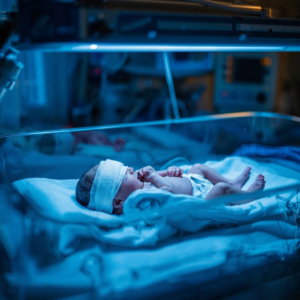
This is the rarest type and is caused by an underlying medical condition, rather than an immature liver. It almost always appears within the first 24 hours of birth. Potential causes include a blood type incompatibility between mother and baby (like Rh disease), an internal infection, or a biliary obstruction (blockage in the bile ducts). Pediatricians monitor this closely and treat it with phototherapy (light therapy).
Blood Incompatibility: If the mother and baby have different blood types (like Rh or ABO incompatibility), the mother’s antibodies may attack the baby’s red blood cells, causing a rapid release of bilirubin.
Underlying Conditions: Rare cases may be caused by internal bruising from birth, liver malfunctions, enzyme deficiencies (like G6PD), or infections (sepsis).
Because these underlying issues cause a rapid, heavy spike in bilirubin levels, pediatricians treat pathological jaundice as an urgent priority, usually starting phototherapy (light therapy) or other medical treatments immediately to keep the baby safe.
Who is Affected? (The Percentages)
Jaundice is incredibly common, though the severity varies based on several factors:
Group Percentage Affected: Full-term infants Approximately 60%
Pre-term infants (before 37 weeks) Approximately 80%
Babies of East Asian/Mediterranean descent: Higher risk due to genetic factors
Diabetic mothers10%-30% of their babies may develop jaundice.
Modern Screening Procedures for Newborn Jaundice
Hospitals and midwives no longer just “look” at a baby to see if they look yellow. Instead, they use a mandatory, objective testing approach to keep newborns safe:
- Visual Assessment: Doctors and nurses check the baby at least every 12 hours. Jaundice typically starts at the head and moves down to the toes.
- Transcutaneous Bilirubin (TcB) Skin Sensor: A non-invasive “light meter” is pressed against the baby’s forehead or chest. This provides an instant estimate every 12 hours without a needle prick.
- Total Serum Bilirubin (TSB) Heel Prick: If the skin sensor reading is high, a precise blood test is performed via a quick heel prick to get the exact measurement.
- Escalation of Care Zone: If those blood numbers rise too fast, the baby is fast-tracked to the NICU for high-intensity light therapy as a proactive safety buffer before it becomes an emergency.
- Universal Pre-Discharge Check: Every single baby is screened one final time between 24 and 48 hours of age before they are allowed to leave the hospital.
⚠️ WARNING FOR PARENTS: ⚠️
- Your baby develops visible yellowing within the first 24 hours after birth.
- The jaundice spreads quickly down to your baby’s abdomen, arms, or legs.
- Your baby is extremely lethargic, difficult to wake up for feedings, or isn’t producing at least 6 wet diapers a day.
Why Universal Screening Matters: Understanding Kernicterus
It is easy to wonder why hospitals and midwives are so incredibly strict about tracking a newborn’s yellow skin tone. The reason for this rigorous monitoring is to prevent a rare, severe condition called Kernicterus.
When bilirubin levels climb too high in the bloodstream, the excess pigment can cross the blood-brain barrier and deposit into the baby’s brain tissue. If left untreated, this can cause permanent neurological damage, affecting a child’s hearing, vision, and motor skills.
The good news is that Kernicterus is entirely preventable. Because of the modern, objective screening tools used today—like the painless skin sensors and proactive “Escalation of Care” buffers—doctors catch rising numbers days before they ever reach a dangerous level. Routine screening ensures that what starts as standard newborn jaundice never becomes a medical emergency.
Treatment: The “Cure”
Most cases of jaundice resolve on their own as the liver matures and the baby begins to eat and poop more. If levels are too high, treatments include:
- Phototherapy: The baby is placed under special blue-spectrum lights that break down bilirubin so it can be excreted.
How Times Have Changed: An Important Note on Sunlight – If you have older children or grandchildren, you might remember different advice! When my own son was born back in 1984, the standard instruction from our pediatrician was simply to place him in a sunny window for about 15 minutes, twice a day. He was born 2 weeks early and was jaundiced. We placed him on a blanket on a table on the front porch for 15 minutes every morning , or my husband would hold him in the sun for 15 minutes. My husband would get up, put on his robe, and take our son out on the porch. We also placed him on the floor on a blanket in front of a sliding glass door for 15 minutes in the early afternoon. It took about 2 weeks before his jaundice cleared up.

While the sun does emit the blue-spectrum light needed to break down bilirubin, modern medical guidelines no longer recommend direct sunlight for newborns. Over the years, research has shown that unfiltered sunlight carries a high risk of sunburn to a newborn’s incredibly delicate skin and can lead to dangerous overheating or dehydration. Today, hospitals use precise, specialized medical LED lights that filter out harmful ultraviolet (UV) rays, keeping the baby completely safe and at a stable temperature while they heal.
- Enhanced Feeding: Increasing breastfeeding or supplementing helps the baby pass bilirubin through their system.
- Intravenous Immunoglobulin (IVIG): Used if the jaundice is caused by blood type incompatibility to stop the breakdown of red blood cells.
- Exchange Transfusion: Used only in rare, emergency cases where bilirubin is dangerously high. A baby’s blood is repeatedly withdrawn and replaced with donor blood to quickly lower levels.
Does your baby have any specific risk factors, such as being born a few weeks early or having a different blood type than yours?