Shopping for a baby’s first Christmas is different from shopping for anyone else on the list. A baby under one cannot tell you what they like, cannot unwrap much on their own, and will likely forget the gift by January. None of that makes the choice unimportant. The right toy at this age does real work: it trains a hand to grip, an eye to track, a mind to notice that one thing causes another. This guide sorts gifts for babies under one by the skill each one builds, so you can shop for what actually helps a baby grow, not just for what looks good under the tree.
What a Baby Under One Actually Notices and Needs
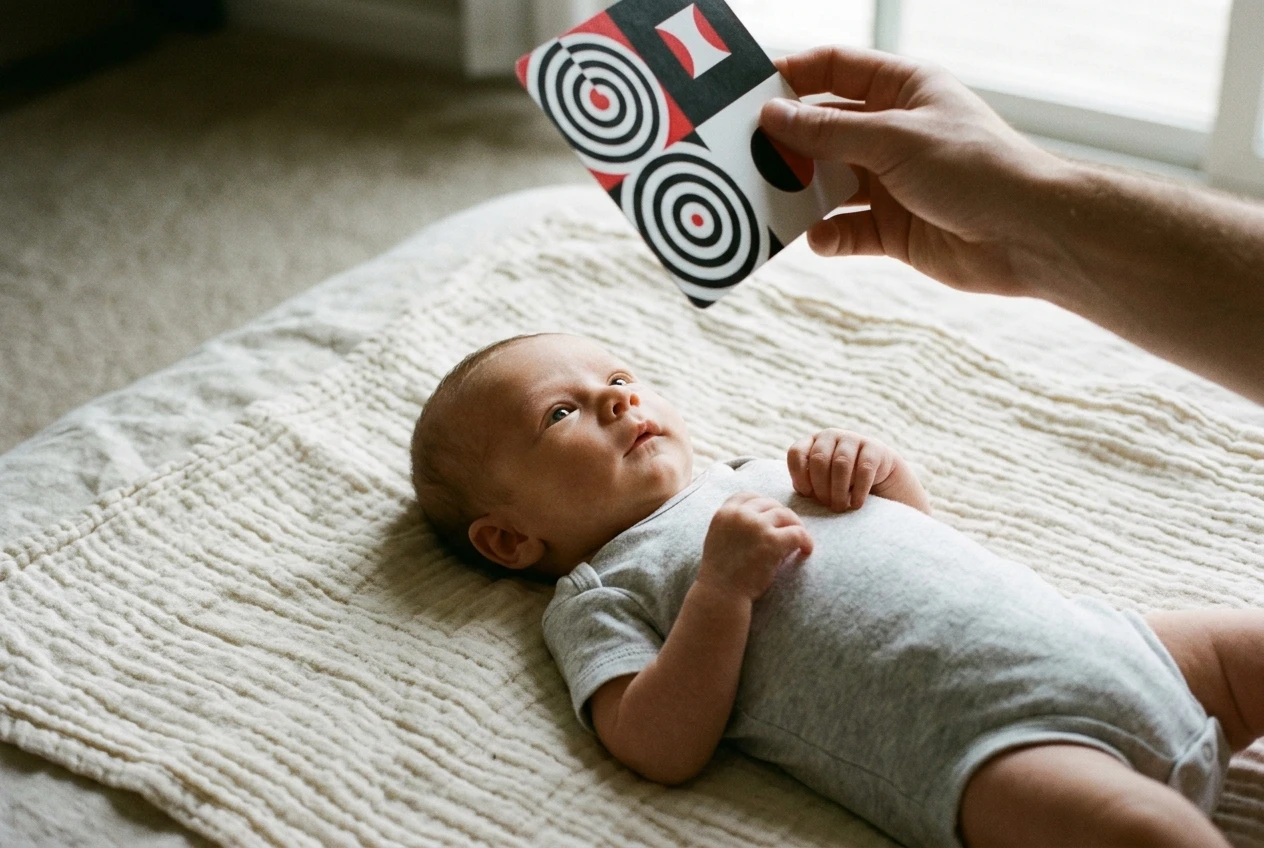
A newborn’s world is small and blurry. In the first few months, a baby sees best at a distance of eight to twelve inches, which is about the distance from a parent’s face while feeding. High contrast matters more than bright color at this stage, because the visual system is still learning to pick out edges and shapes. Black, white, and red patterns register more clearly to a very young baby than pastel colors do.
By three to six months, grasping starts to take over from looking. A baby reaches for things, misses, reaches again, and slowly links what the hand does to what the eye sees. This is the stretch where rattles, soft blocks, and anything that makes a sound when batted or shaken start to earn their keep.
Past six months, most babies can sit up, which frees both hands for exploring an object at once. This is when cause and effect becomes the main event: press a button, hear a sound; drop a ball, watch it roll; stack a cup, knock it down. Toward the first birthday, fine motor skill sharpens further, and a baby who could only swipe at an object months earlier can now pick up something small between thumb and forefinger.
Knowing where a baby sits in that range tells you more than any gift description will. A rattle that delights a four month old will likely get tossed aside, unexamined, by a ten month old who wants to open and shut things instead.
Sensory Toys That Build Hand Eye Coordination
Hand eye coordination is the slow, repeated work of getting the hand to do what the eye has already figured out. Toys that reward a reach, a grab, or a swipe give a baby a reason to keep trying.
Textured balls that are easy to grip, with ridges or bumps a small hand can close around, work well from around four months onward, once a baby can bring both hands to the middle of the body. A ball that rolls a short distance when nudged also introduces the idea that an action has a visible result, which sets up cause and effect learning later in the year.
Rattles remain useful longer than many parents expect. A rattle that is light enough to lift with one hand but still makes a clear sound rewards a baby for shaking it, and that feedback loop, shake, hear, shake again, is exactly the kind of repetition that strengthens the connection between movement and outcome.
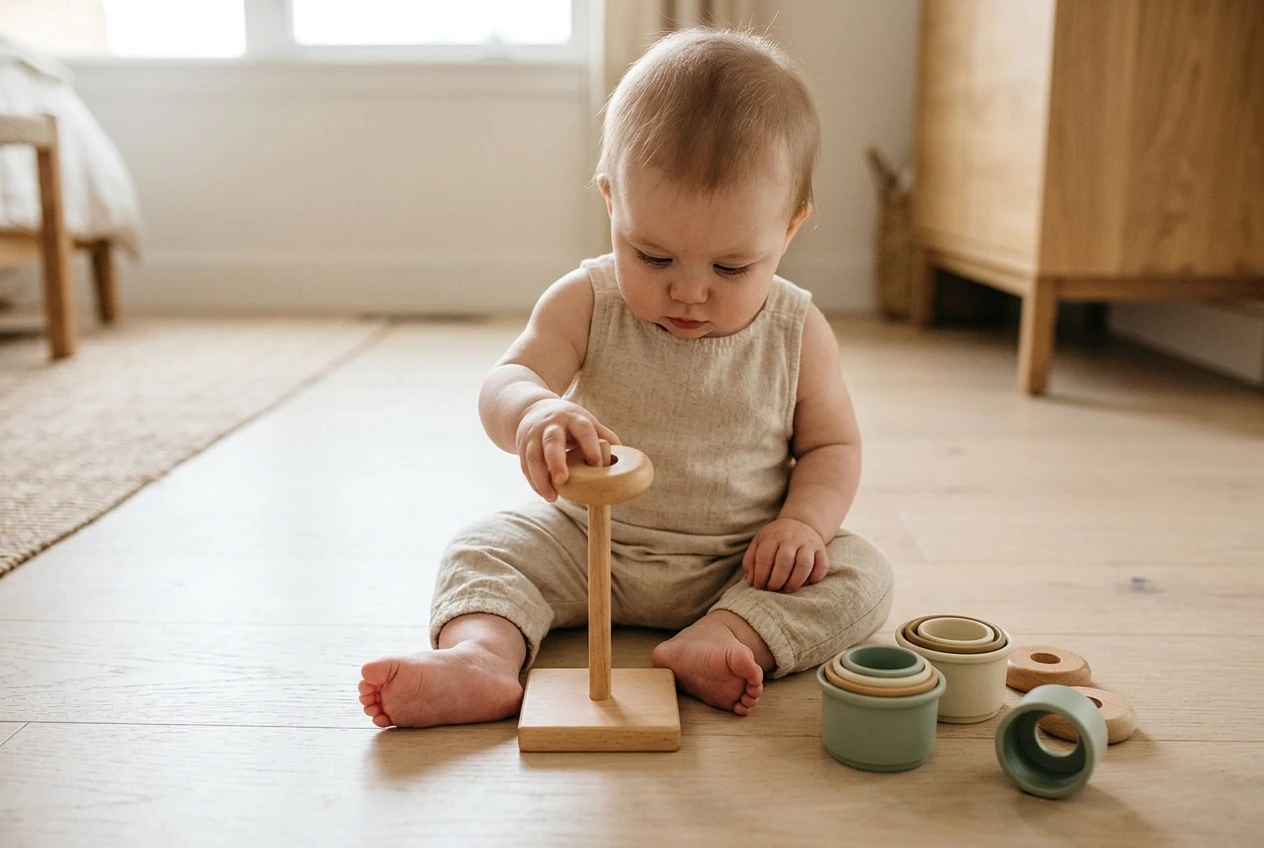
Stacking rings and nesting cups ask for more precision. Around eight to twelve months, a baby starts to notice that a smaller cup fits inside a bigger one, or that a ring has to line up with a post before it will slide down. These toys do not need batteries or sound effects to hold attention; the physical puzzle of fitting one piece into another is the whole point.
Soft blocks with different textures on each face, some smooth, some ridged, some with a crinkle sound built in, let a baby compare surfaces by touch, which is still a novel and interesting activity to a baby’s exploring hands and mouth.
Soft Books and Cuddle Toys for Quiet Bonding Time
Not every gift needs to drive a skill directly. Some of the best first Christmas presents support the quiet, repeated moments between a baby and whoever is holding them, and those moments do plenty of developmental work on their own.
Cloth and board books with high contrast images suit the youngest babies well, since the simple black, white, and bold-color pages are easier to focus on than busy, pastel illustrations. A board book with thick, baby-safe pages a parent can turn while a baby watches also introduces the rhythm of a book: pages turn, a new picture appears, and eventually a page gets a reaction of its own from the baby.
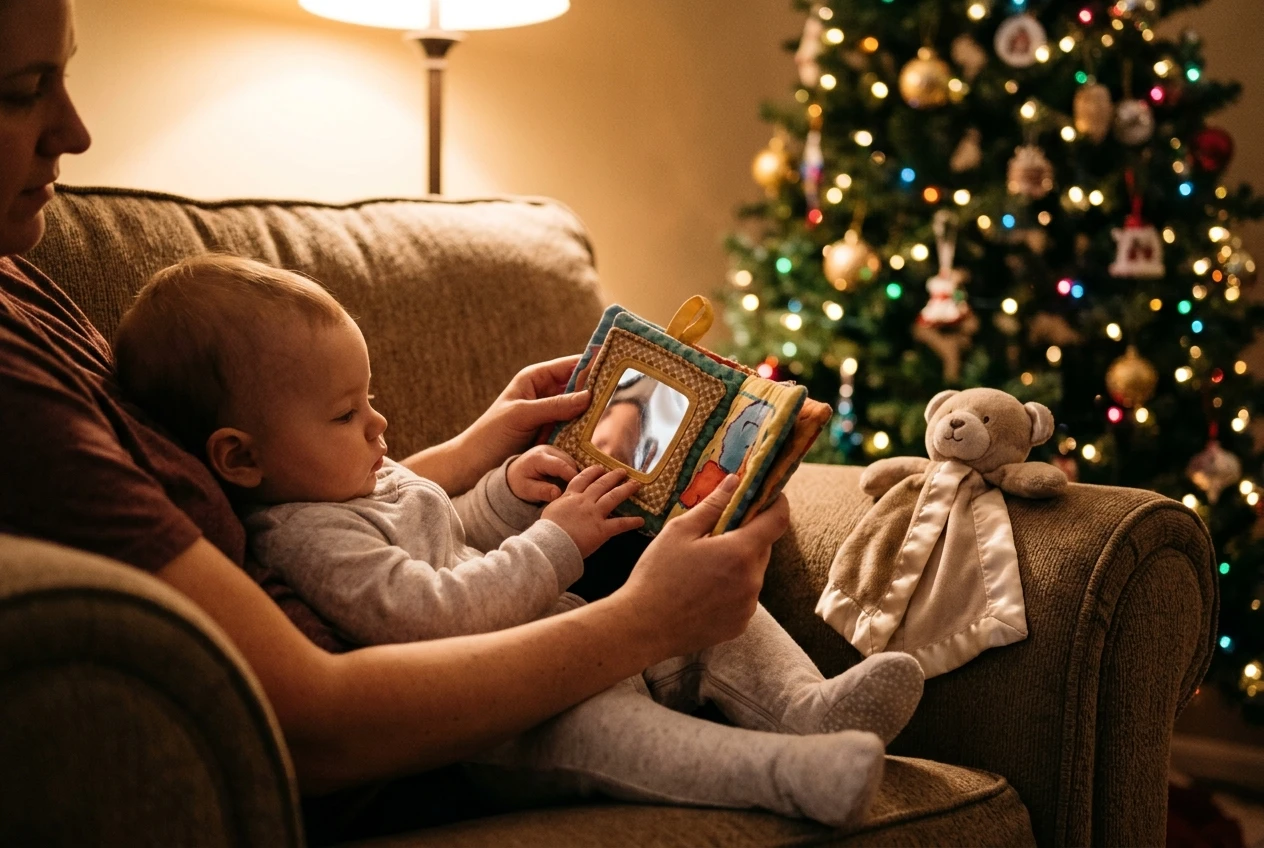
Soft books with crinkle pages, a hidden mirror, or a tag to chew on add a tactile layer that keeps a baby interested past the age where pictures alone are enough. These work well tucked into a diaper bag, since they hold up to drool and a baby’s habit of mouthing everything within reach.
A cuddle toy, whether a soft animal, a lovey with a satin edge, or a simple weighted plush, gives a baby something familiar to hold during naps, car rides, or any moment a parent’s arms are not free. These do not teach a skill in the way a stacking toy does, but the comfort and familiarity they offer support a baby’s sense of security, which underpins everything else they are learning to do.
Gender Neutral Picks That Work for Any Baby
Most of what helps a baby grow in the first year has nothing to do with whether the baby is a boy or a girl, which is why a gender neutral list covers the bulk of good options. A high contrast cloth book, a textured ball, a set of stacking cups, a soft block set in neutral tones like cream, gray, or sage green: all of these work exactly as well regardless of who is unwrapping them.
Wooden rattles and teethers in natural, unpainted wood or simple geometric shapes fit this category too. They tend to suit any nursery color scheme, which matters to a grandparent or gift buyer who does not know the exact decor a baby’s room is in, and they avoid the question of pink versus blue entirely.
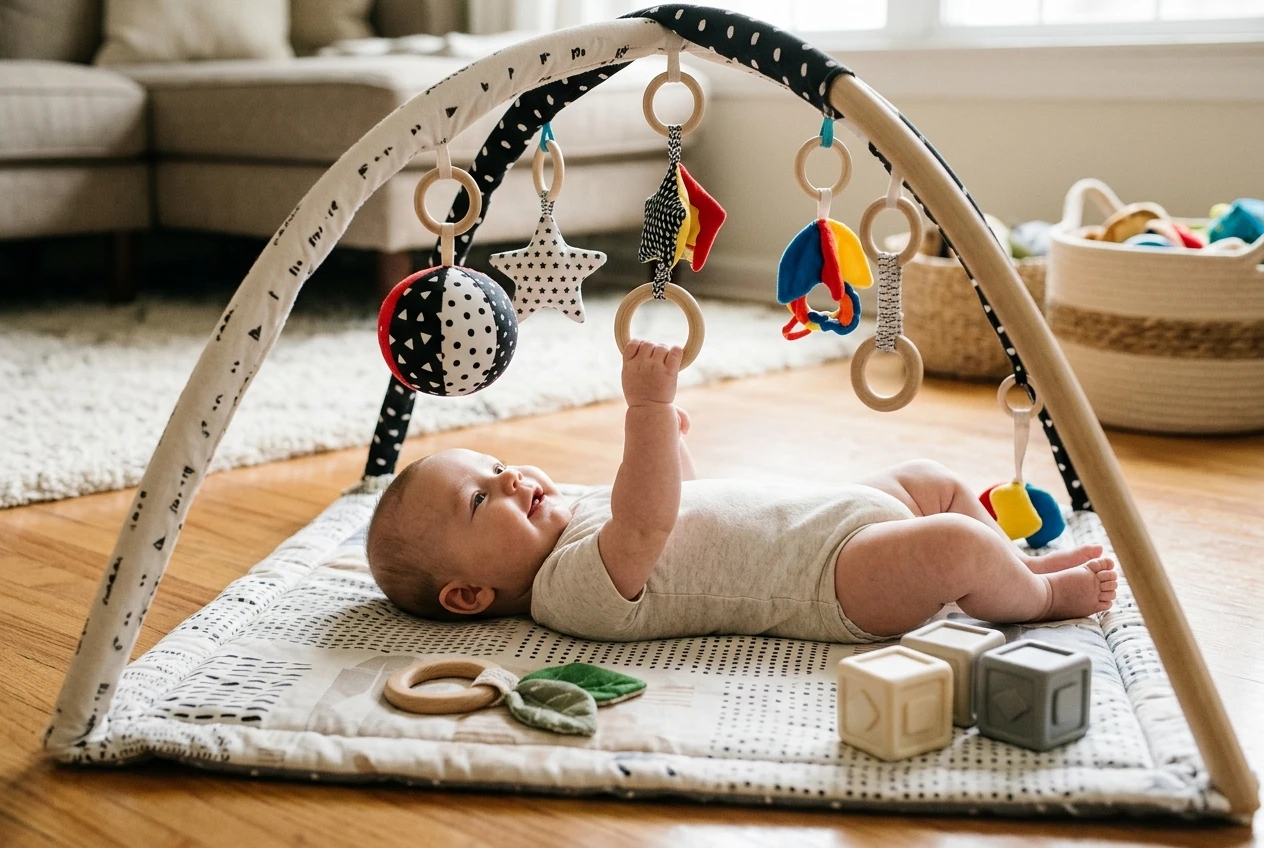
A play mat or activity gym with hanging toys in black, white, and primary colors is another safe, useful choice. These mats support a baby from the newborn stage, when they lie under the hanging toys and simply look, through the sitting stage, when the same toys get batted, grabbed, and chewed.
Shopping gender neutral is not a compromise. For a baby under one, the skills being built, grip, tracking, cause and effect, do not split along gender lines, so a neutral gift list is simply a practical one.
A Few Pink and Blue Options for Parents Who Want Them
Some parents and grandparents want a gift that fits a specific nursery color scheme or simply feels traditionally gendered, and there is nothing wrong with that preference if it is what the gift buyer wants.
For a baby girl, a soft plush rattle or teether in pink or lavender tones covers the same developmental ground as any neutral version, just in a different color. A pink stacking cup set or a soft book with a floral or pastel cover works the same way: the skill being built does not change, only the palette.
For a baby boy, the same logic applies with a blue or navy version of a rattle, textured ball, or soft block set. A blue crinkle book or a stacking toy in primary blues gives the same tactile and visual experience as a neutral one.
The point of including a few colored options is not to suggest that pink and blue toys work differently than neutral ones. They do not. It is simply to acknowledge that some gift buyers have a color preference, and a good gift guide should not force a neutral choice on someone who already knows what they want.
Practical Gifts That Get Used Long After the Holidays
Some of the most appreciated gifts for a baby’s first Christmas are not toys at all, but items a parent will reach for every day long after the holiday season ends. A baby under one grows through several clothing sizes in a single year, and a well chosen set of clothes in an upcoming size, rather than a newborn size that may already be outgrown by Christmas, tends to get real use.
A durable bib set, a set of burp cloths, or a few extra swaddle blankets in simple, washable fabric solve a problem every parent of a young baby has: there are never quite enough clean ones on hand. These are not glamorous gifts, but they are the kind that get used weekly rather than sitting in a toy bin.
A baby bathtub insert, a set of safe bath toys, or a soft hooded towel supports a daily routine rather than a single play session. Similarly, a simple board book collection, built up a few titles at a time, becomes part of a bedtime routine that a parent repeats every night, which means the gift keeps earning its place well past the holiday.
For grandparents or extended family who want to give something with lasting value, a contribution toward a baby’s first savings account or a simple keepsake, like a photo book or a padded milestone card set that gets filled in over the year, offers something a family keeps rather than something a baby outgrows by spring.
Safety Checks to Run Before You Buy Anything
A baby under one explores almost everything by putting it in their mouth, so safety has to come before cuteness or even developmental value. A few checks are worth running on anything before it goes under the tree.
- Check the toy against any small parts warning on the packaging, and if a toy has a removable piece smaller than about the size of a ping pong ball, it is not appropriate for a baby who still mouths objects.
- Look for secure stitching on any plush toy, since loose seams or glued-on eyes and noses can come loose and become a choking hazard.
- Favor toys with no button batteries accessible to a baby, since these batteries are dangerous if swallowed and some toys house them behind only a simple screw panel.
- Check fabric and plastic toys for any age recommendation printed on the packaging, since manufacturers test toys for the age range they state, and a toy rated for toddlers may include features unsafe for a baby under one.
- Avoid long cords, ribbons, or strings longer than seven inches on any toy that might end up near a crib, since these present a strangulation risk.
None of these checks take long, but running through them before buying, rather than after a gift is already wrapped and given, saves the awkwardness of having to take something back or quietly remove it from use.
Best Materials to Use for Newborn to 1 Year Old
Material choice matters almost as much as the toy’s design, since whatever a baby holds is likely to end up in their mouth within minutes.
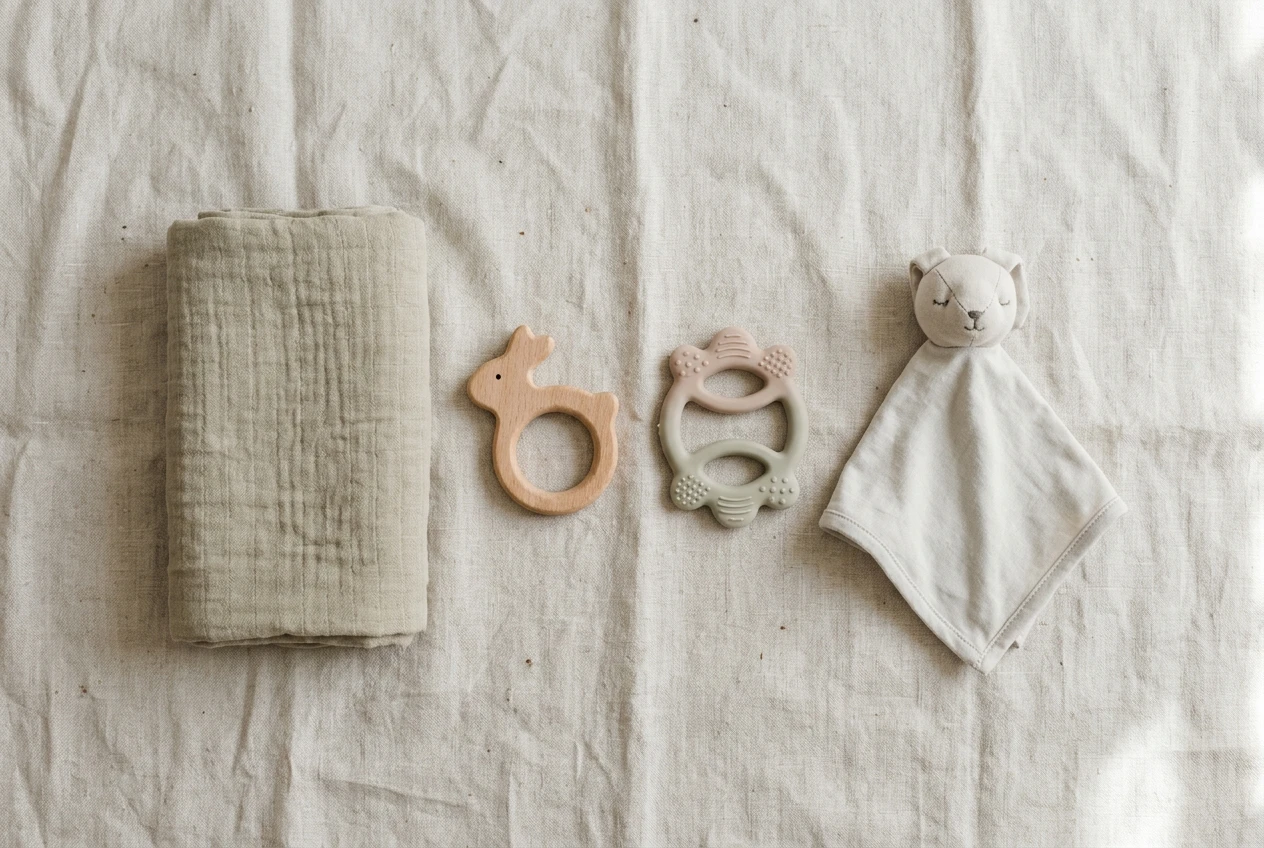
Untreated or food-grade finished wood is a durable, long lasting option for rattles, teethers, and stacking toys, and it tends to hold up to years of chewing and dropping better than many plastics. Look for a finish described as food safe or non-toxic if the wood is painted or sealed at all.
Silicone has become a common material for teethers and some soft toys, since it is naturally free of the chemicals found in some older plastics, and it can typically be sanitized by boiling or running through a dishwasher.
Organic cotton and bamboo fabric show up often in soft books, cuddle toys, and swaddle blankets, and both tend to be gentle on sensitive newborn skin while holding up to repeated washing, which matters given how often these items get washed in the first year.
BPA free plastic remains common in rattles and bath toys, and while plastic quality varies widely, a toy labeled BPA free and phthalate free has at least cleared a baseline safety standard that many parents look for.
Whatever the material, washable and durable should take priority over delicate or decorative. A baby’s gift will be dropped, chewed, and likely dragged across a floor more than once in its first few months of use, and the toys that survive that treatment are the ones that keep earning their place in the rotation.
Once a baby’s first Christmas is behind you, the gift list only grows more interesting as new skills come online. Our next guide in this series covers Christmas gifts for toddlers aged 1 to 2, with the same approach of sorting by the skill each gift builds, so you can keep shopping by age as the child in your life grows into walking, talking, and the next round of first discoveries.