
As an Amazon Associate, I earn from qualifying purchases with no additional cost to you.
Baby-led weaning has become the default recommendation in a lot of parenting circles, often reduced to a single rule: start at 6 months. That rule is a reasonable starting point, but it skips over the part that actually matters more: whether your particular baby is ready for it, and what to do if they’re not quite there yet. Age gives you a window. Readiness tells you when to open it.
What Baby-Led Weaning Actually Means, Compared to Spoon-Feeding Purees
Baby-led weaning is an approach to starting solid foods where the baby feeds themselves soft, graspable pieces of food from the start, rather than being spoon-fed smooth purees. Instead of rice cereal or blended squash on a spoon, a baby doing BLW might be handed a steamed strip of sweet potato, a ripe banana cut into a manageable shape, or a piece of soft-cooked broccoli with a stem to hold onto.
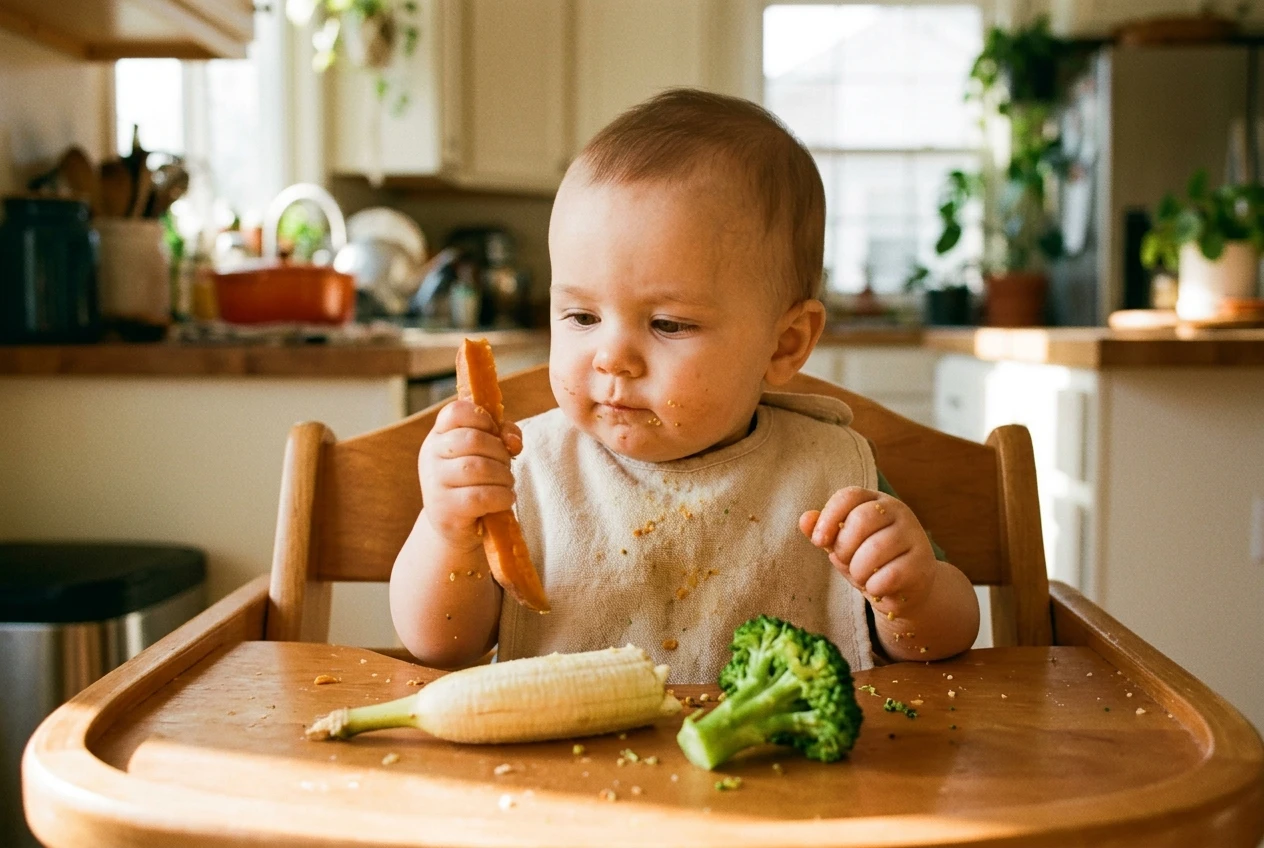
The core difference is control. With spoon-feeding, a caregiver decides the pace, the amount, and the texture, and moves the food into the baby’s mouth. With baby-led weaning, the baby picks up the food, brings it to their mouth, and decides how much to gnaw, mash, or swallow. Purees can still show up in a BLW approach, loaded onto a pre-loaded spoon the baby holds themselves, but the defining feature is that the baby is doing the feeding, not the parent.
Neither method is right or wrong on its own. Plenty of babies are spoon-fed purees for a few months and then move into finger foods without any issue, and plenty of babies skip purees entirely. What matters for this decision is less about which camp you want to belong to and more about whether your baby’s body is ready for the method you pick.
The Readiness Signs That Matter More Than the Calendar
A baby’s age tells you roughly where they should be developmentally, but it doesn’t confirm it. Two babies born the same week can be in very different places by 5 or 6 months, and the signs below are a better gauge than the date on the calendar.
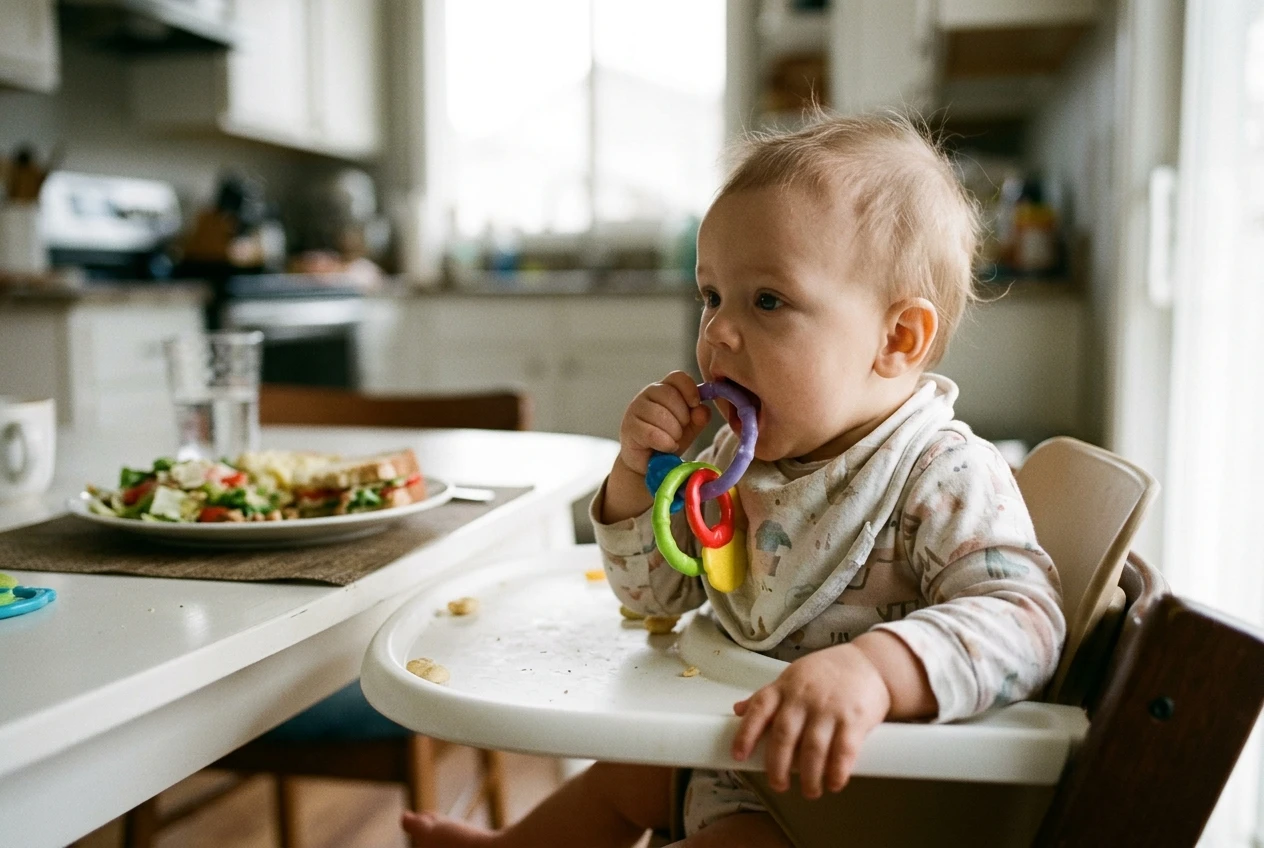
Sitting with minimal support. A baby doing baby-led weaning needs to sit upright in a high chair with little or no propping. If a baby slumps to the side or needs constant hand support to stay upright, their trunk control isn’t developed enough to manage food in their mouth safely while seated.
Loss of the tongue-thrust reflex. Young infants have a reflex that pushes foreign objects, including food, back out of the mouth with the tongue. This reflex usually fades somewhere between 4 and 6 months. If a baby is still reflexively pushing food out every time it touches their lips, they’re not ready yet, regardless of age.
The ability to bring objects to the mouth with some accuracy. Babies who are ready for finger foods have usually been grabbing toys and other objects and guiding them to their own mouths for weeks already. This shows the hand-eye-mouth coordination that baby-led weaning depends on.
Interest in food. Reaching for your plate, watching every bite you take, opening their mouth when food comes near. This on its own isn’t enough to start, but paired with the physical signs above, it’s a reasonable green light.
Chewing or gumming motions, even without teeth. Teeth are not required for baby-led weaning. What matters is that the baby can move their jaw up and down and side to side to mash food between their gums.
A baby who checks all of these boxes at 5 months is a better candidate than one who’s hit 6 months on the calendar but still slumps in the high chair and still thrusts the tongue.
Why Most Guidance Points to Around 6 Months
The reason most pediatric guidance, including the American Academy of Pediatrics, lands on roughly 6 months as the starting point for solids isn’t arbitrary. It lines up with a cluster of developmental changes that tend to happen around the same time.
A baby’s iron stores, built up during pregnancy, typically start to run low around this age, which is part of why introducing iron-rich solid foods matters. The digestive system has also matured enough by this point to handle foods beyond breast milk or formula. And developmentally, 6 months is roughly when the readiness signs described above, sitting with support, losing the tongue-thrust reflex, bringing objects to the mouth, tend to cluster together in most babies.
Six months functions as a midpoint estimate built from population averages, not a hard deadline that applies identically to every baby. Some babies show every readiness sign at 5 months. Others aren’t quite there until 7. The guidance gives a range to watch for the signs within, not a date to circle on the calendar and act on regardless of what the baby is doing.
Babies Who Should Wait, and Roughly How Long
Some babies benefit from a slower start, and knowing which category a baby falls into is more useful than just waiting a vague “little longer.”
Babies born premature. Readiness should generally be judged by adjusted age (counting from the original due date, not the birth date), not chronological age. A baby born two months early may need an extra two months before the readiness signs show up, which can push the realistic start closer to 8 months chronological age. A pediatrician familiar with the baby’s history is the right person to confirm this timeline.
Babies with low muscle tone or motor delays. Conditions that affect trunk control or oral motor coordination, whether diagnosed or simply observed by a pediatrician, mean a baby may need extra time to sit independently and manage food safely in the mouth. These babies often benefit from an occupational therapy or feeding therapy evaluation before starting any solids, not just baby-led weaning specifically.
Babies with a history of reflux or swallowing difficulty. If a baby has had trouble coordinating sucking, swallowing, and breathing with liquids, introducing solid textures should happen under a pediatrician’s guidance, and possibly with a modified approach rather than full baby-led weaning from day one.
Babies who are still showing a strong tongue-thrust reflex past 6 months. Rather than forcing the issue, waiting a few more weeks and rechecking is the safer path.
For most of these situations, “wait” doesn’t mean waiting indefinitely. It means waiting until the specific readiness signs show up, which might be a matter of weeks, and checking in with a pediatrician along the way rather than guessing. A pediatrician or a pediatric feeding specialist can also help distinguish between a baby who just needs a bit more time and one who needs a different approach to solids altogether, such as spoon-feeding purees for a period before transitioning to finger foods.
The Benefits Parents and Pediatric Feeding Specialists Point To
The case for baby-led weaning usually rests on a handful of specific advantages, not just a general preference for self-feeding.
Self-regulation of intake. Because the baby controls how much goes into their mouth and when, baby-led weaning is often credited with supporting a baby’s natural ability to stop eating when full, rather than being encouraged to finish a jar or a bowl.
Oral motor development. Gnawing, mashing, and chewing whole pieces of food works the jaw and tongue muscles differently than swallowing smooth purees does. Some pediatric feeding specialists point to this as useful preparation for speech development and for an easier transition to table food later.
Family meals, earlier. Because a baby doing baby-led weaning eats modified versions of what’s already on the table (soft, cut appropriately, without added salt or honey), it’s often easier to feed them alongside the rest of the family rather than preparing separate purees.
Exposure to a wider range of textures and flavors sooner. Babies who skip the puree stage are handling and tasting distinct foods, rather than blended combinations, from the start. Some parents find this reduces picky eating later on, though this varies a lot by child and isn’t guaranteed.
These benefits are real for many families, but they’re not universal guarantees. A baby who does purees first can absolutely develop strong oral motor skills and eat a wide variety of foods later. Baby-led weaning is one path to those outcomes, not the only one.
The Downsides and Choking Concerns Worth Weighing Honestly
The two concerns that come up most with baby-led weaning are mess and choking, and they deserve a straight answer rather than a dismissive one.
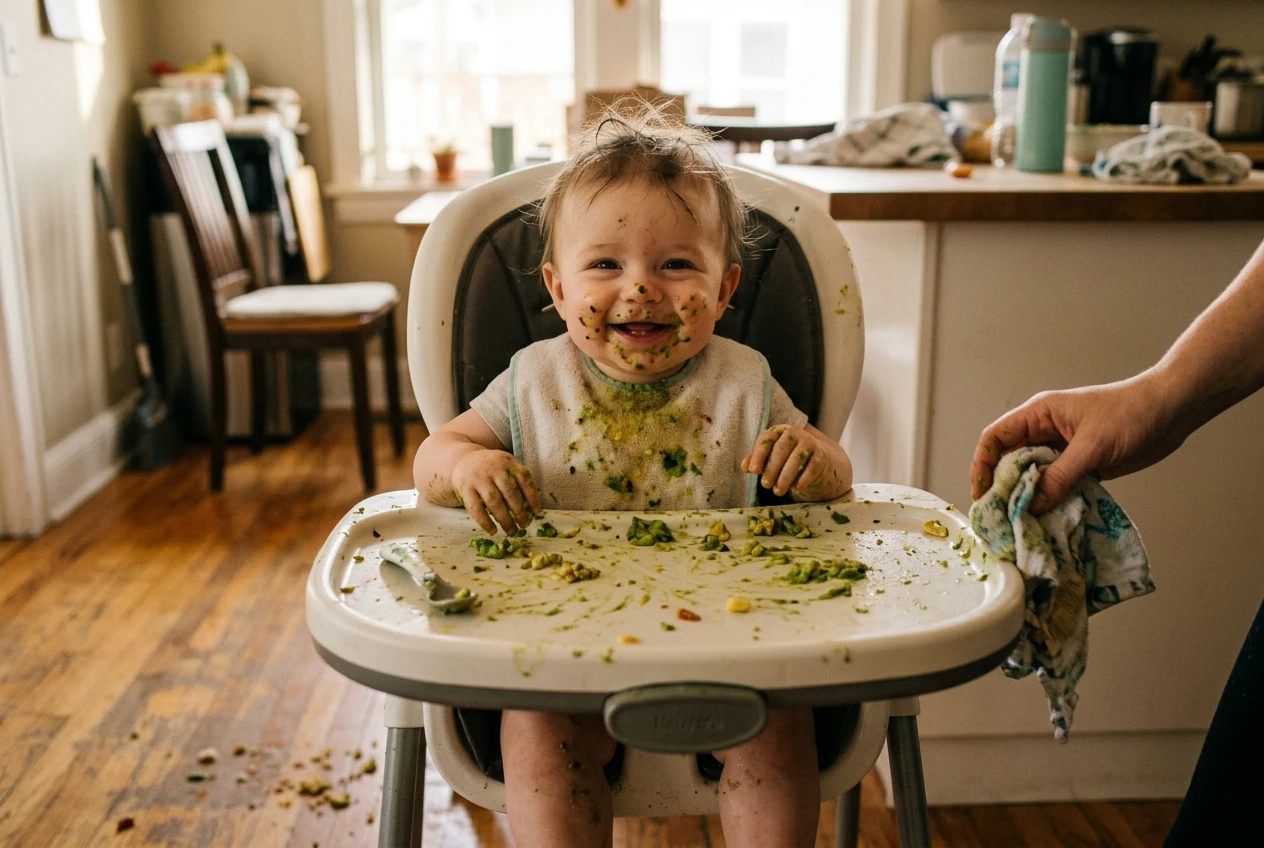
The mess is real and it’s not minor. Early baby-led weaning sessions often involve more food on the floor, the high chair, the baby’s hair, and the wall than in the baby’s mouth. This is a normal part of the learning process, since babies are practicing a motor skill, but it does mean more cleanup per meal than spoon-feeding typically involves, at least for the first several weeks.
The choking question is the one that keeps parents up at night, and it’s worth being precise about. Gagging and choking are not the same thing, even though they can look similar and both are alarming to witness. Gagging is a normal, protective reflex: a baby pushes food forward with coughing, gagging sounds, and sometimes a red face, and it resolves on its own within seconds. It happens often in early baby-led weaning as the gag reflex sits further forward in a baby’s mouth than in an adult’s and gradually moves back with practice. Choking is different: it means an airway is actually blocked, and it typically looks like silence, an inability to cough or cry, and a change in skin color.
Research comparing baby-led weaning to traditional spoon-feeding has generally not found a higher rate of actual choking incidents between the two approaches, when food is prepared appropriately for a baby’s stage. But “when prepared appropriately” is doing real work in that sentence. High-risk foods like whole grapes, whole nuts, popcorn, hard raw vegetables, and round pieces of hot dog carry choking risk regardless of which feeding method a family uses, and those risks don’t disappear just because a baby is older or more experienced.
The honest summary: baby-led weaning doesn’t appear to be inherently more dangerous than spoon-feeding when done correctly, but “done correctly” means the person supervising needs to understand food preparation, recognize the difference between gagging and choking, and never leave a baby unattended with food. That’s a real responsibility, not a footnote.
How to Start Safely Once You’ve Decided to Try It
Once the readiness signs are there, a few practical habits make the start of baby-led weaning considerably safer.
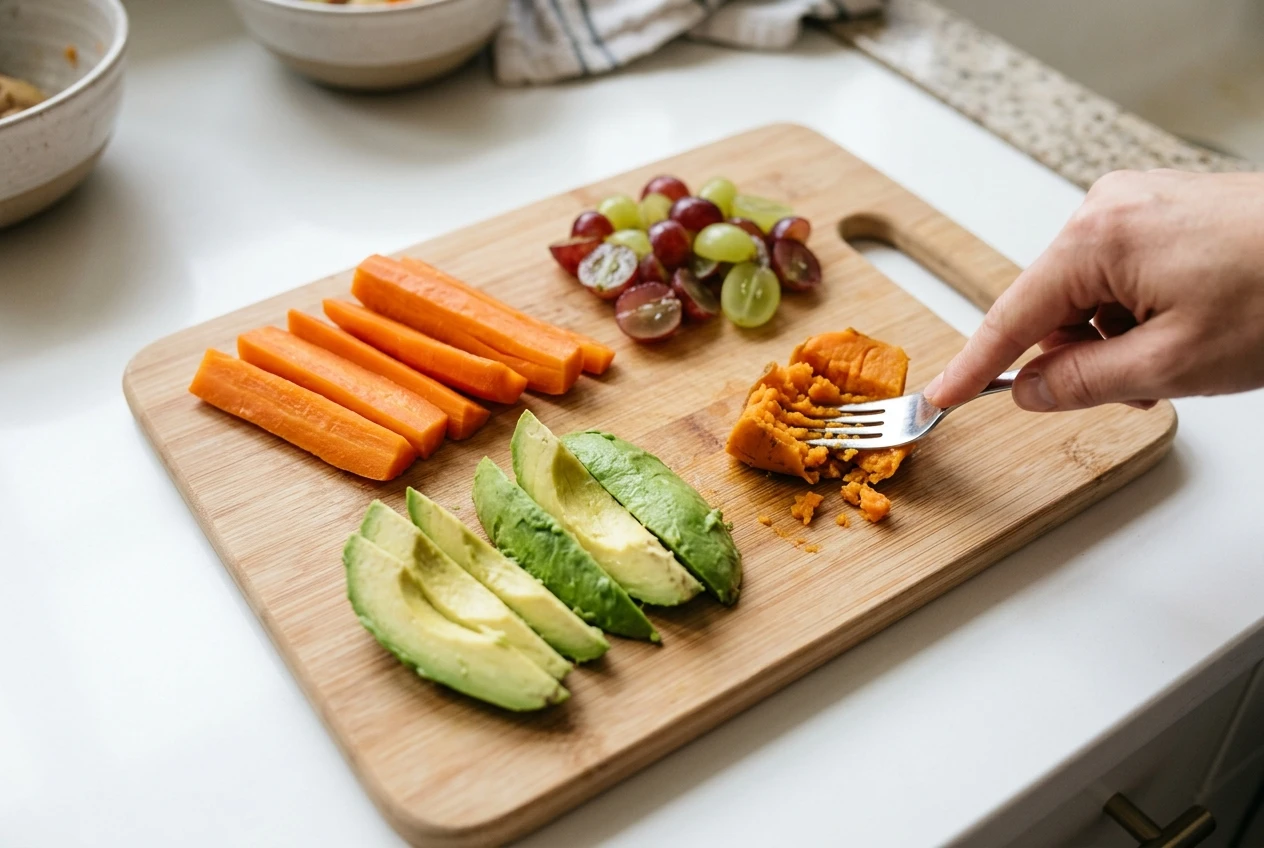
- Cut food into the right shapes, not just small pieces. Early on, food cut into pieces about the length and width of an adult finger gives a baby something to grip with their whole fist, since pincer grasp hasn’t developed yet. Round foods like grapes or cherry tomatoes should always be cut lengthwise into quarters, not just in half.
- Cook food until it’s soft enough to mash between two fingers. If you can’t squish it easily, a baby’s gums can’t either.
- Always sit the baby upright, ideally at a 90-degree angle, in a high chair with foot support. Reclined seating changes the mechanics of swallowing and increases risk.
- Never leave a baby alone with food, even for a few seconds. This includes stepping away to answer the door or grab a napkin.
- Offer one new food at a time when possible, which also makes it easier to track any reaction.
- Skip the high-risk foods listed above (whole grapes, whole nuts, hard raw vegetables, popcorn, chunks of nut butter, round pieces of sausage or hot dog) regardless of how the rest of feeding is going.
- Learn the difference between gagging and choking before the first meal, not during it. Knowing what normal gagging sounds and looks like ahead of time makes it much easier to stay calm when it happens, which it likely will.
Taking an infant and child first aid and CPR course before starting solids, whichever feeding method a family chooses, is one of the most practical things a parent can do. Many hospitals, community centers, and the American Red Cross offer these courses, and they cover exactly what to do in the rare event that a piece of food does become lodged.
The Life Saving Device You Should Have in Your Kitchen and Diaper Bag
Alongside knowing infant choking first aid, having a dedicated anti-choking rescue device on hand adds another layer of preparedness that a lot of parents don’t think about until they need it. These are suction-based devices designed specifically to help clear an obstructed airway when back blows and abdominal thrusts haven’t worked, and they’re built in compact sizes meant to travel.https://amzn.to/4s4McpD
One should live somewhere accessible in the kitchen, since that’s where most mealtime choking incidents happen, and a second, smaller one is worth keeping in the diaper bag for meals away from home, at a grandparent’s house, a restaurant, or daycare pickup. The idea isn’t to replace first aid training or to skip learning infant CPR. It’s a backup tool for the moments when training alone isn’t enough, sitting in reach precisely because choking incidents give you seconds, not minutes, to respond.
Before buying one, read the manufacturer’s instructions for the specific device thoroughly, and practice assembling it (without using suction on an actual person) so that the steps are familiar before an emergency ever happens. A device you’ve never handled before is far less useful in a crisis than one you’ve already opened and understood.
Starting solid foods, whether through baby-led weaning, spoon-feeding, or some combination of both, is a milestone worth paying close attention to rather than rushing. Watching for the actual readiness signs, talking to a pediatrician about anything that doesn’t fit the typical timeline, and preparing the kitchen with the right knowledge and the right tools will do more for a baby’s safety than any specific age on a calendar ever could.