
Babies who slept through the night in August suddenly wake at 5 a.m. in September. A toddler who went down at 7 p.m. all spring now fights bedtime until well past 8. None of this is random, and it isn’t a sign that something has gone wrong with your child’s sleep. Daylight hours, room temperature and clock changes all feed directly into the biological system that tells a baby’s body when to be awake and when to sleep, and every major seasonal shift disturbs that system in a specific, predictable way. Knowing which mechanism is at work tells you what to actually do about it.
What actually controls your baby’s sleep clock (and why seasons throw it off)
A baby’s sleep is governed by the circadian rhythm, an internal clock run by a part of the brain called the suprachiasmatic nucleus. That clock doesn’t just guess what time it is. It reads light, specifically light hitting the retina, and uses that signal to time the release of melatonin, the hormone that makes a body feel sleepy.
In the evening, falling light levels trigger melatonin release and the body starts winding down. In the morning, rising light suppresses melatonin and the body wakes up. This system is the same one adults have, but a baby’s version is younger, less mature and far more sensitive to light exposure than an older child’s or an adult’s. A newborn’s circadian rhythm isn’t even fully formed until around three to four months, and it keeps calibrating itself against daylight for years after that.
This is exactly why seasons matter so much. Each season changes one or more of the inputs that clock relies on: how early or late the sun rises and sets, how much ambient light leaks into a room at nap time or bedtime, and how warm or cold that room is overnight. Add a clock change on top of that, which shifts the external time without changing a single thing about actual daylight, and you get a baby whose internal clock and the clock on the wall are temporarily pointing in different directions.
None of the four seasonal transitions below work the same way. Spring and the clock change move the daylight window. Summer stretches it. Autumn compresses it gradually. Winter removes morning light almost entirely while adding a temperature and air-moisture problem on top. Each one calls for a different fix.
Spring forward: handling the time change and earlier sunrise wake-ups
The spring clock change is the most abrupt disruption on this list because it happens in a single night rather than gradually. The sun doesn’t actually move; the clock just jumps forward an hour, so a baby who always woke at 6 a.m. solar time is now waking at what the clock calls 7 a.m., and a 7 p.m. bedtime is suddenly happening at what the baby’s body still reads as 6 p.m., too early for melatonin to have risen.
The most reliable fix is to shift gradually rather than all at once. Starting three to four days before the change, move bedtime, naps and wake time by 10 to 15 minutes earlier each day, so by the time the clock changes, your baby’s schedule has already caught up to it. If you didn’t catch it in advance, you can do the same thing in reverse after the change: hold firm on the new clock times and let your baby’s body adjust over three to seven days, using consistent light cues (bright light in the morning, dim light in the evening) to help the internal clock recalibrate faster.
Spring also brings an earlier sunrise on top of the clock change, which compounds the problem for babies in rooms that aren’t fully dark. If your baby’s early waking continues past the week after the change, the sunrise itself, not the clock change, is probably the ongoing cause, and the fix shifts from patience to blackout curtains.
Long summer evenings: getting a toddler to sleep when it’s still bright outside
Summer’s problem isn’t a shift in the clock, it’s a stretched window of daylight that runs straight through a toddler’s normal bedtime. At 7 p.m. in midwinter the sky is already dark; at 7 p.m. in midsummer the sun might still be well above the horizon, and that light is actively suppressing the melatonin release your toddler needs to fall asleep.
This is the one seasonal disruption where the fix is almost entirely about blocking light rather than adjusting timing. A toddler’s room needs to be dark enough at bedtime that it doesn’t matter what the sky is doing outside. Blackout curtains or blinds, not just regular curtains, are doing the real work here, and gaps at the edges of a window frame let in more light than most parents expect once their eyes adjust to the dimmed room. If the room still has a visible strip of daylight along the floor or ceiling after the curtains are drawn, that strip is enough to delay sleep onset in a light-sensitive toddler.
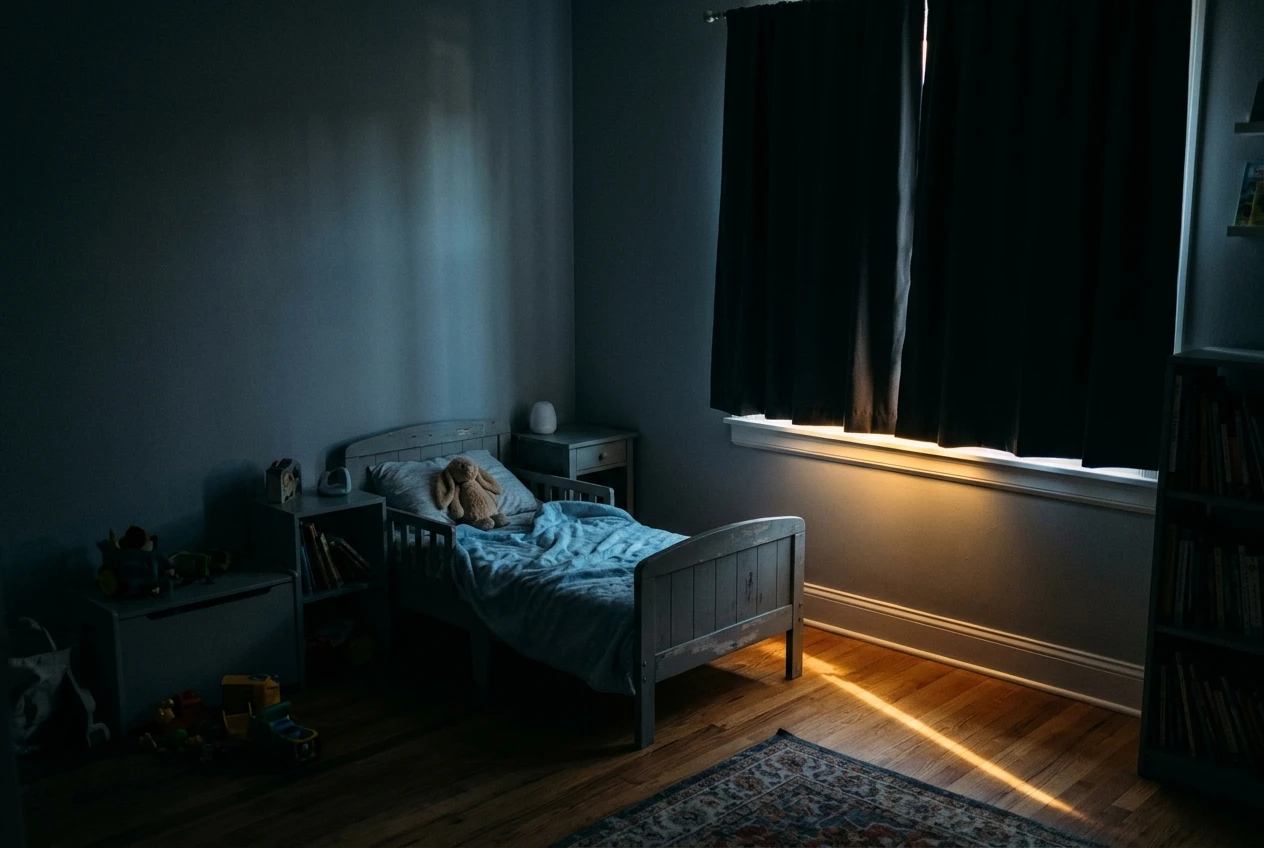
Keep the bedtime routine itself on the same clock-time schedule you’d use in any other season. The temptation in summer is to push bedtime later because it still looks and feels like daytime, but doing that tends to produce an overtired toddler who then fights sleep harder, not an easier bedtime. A consistent, pre-bedtime wind-down with dim household lighting in the half hour before bed helps the body’s melatonin curve start rising even while it’s still bright outside.
Summer heat compounds the light problem, since a toddler who’s warm and overstimulated by a bright room takes longer to settle than one who’s simply tired. Treating the light and the temperature as two separate problems, with two separate fixes, usually works better than treating summer bedtime resistance as one vague issue.
Autumn’s dropping light: the slow slide toward earlier bedtimes and early waking
Autumn is the mirror image of spring, but it unfolds gradually instead of all at once, which makes it easier to miss while it’s happening. As sunset creeps earlier by a few minutes each day, a baby’s circadian rhythm reads that falling evening light as a cue to release melatonin earlier, which in turn can push bedtime earlier and, often, push the next morning’s wake time earlier too.
Parents sometimes describe this as their baby’s sleep “getting worse” in autumn, but what’s usually happening is a schedule sliding earlier across several weeks, not a single disruption with one clear cause. A baby who was reliably asleep by 7:30 p.m. in September might be fighting to stay awake past 6:45 by late October, and waking at 5:30 a.m. instead of 6:30, purely because the light driving their internal clock has moved.

The adjustment here is to let the schedule slide with the light rather than fighting it, up to a point. If your baby’s new, earlier bedtime still gives them the same total sleep they were getting before, an earlier schedule by itself isn’t a problem, just a seasonal shift. Where it becomes worth managing is the early-morning end: if wake time has crept earlier than you want it to stay, blackout curtains in the bedroom prevent the first grey light of an autumn dawn from doing the same job the bright summer sunrise was doing a few months earlier.
The autumn clock change (where clocks move back an hour) usually lands in the middle of this slide and briefly makes things easier, since it effectively gives you an extra hour of daylight back in the evening for a week or two. That reprieve doesn’t last, because the days keep getting shorter regardless of what the clock says, so treat it as temporary rather than a sign the seasonal adjustment is finished.
Winter mornings: dark wake-ups, warmer sleepwear and dry-air considerations
Winter brings three separate issues that often get lumped together as “winter sleep problems” but need three separate responses: a near-total loss of morning light, a colder bedroom, and drier indoor air from heating systems running constantly.
Dark winter mornings mean a baby’s circadian rhythm no longer gets the natural “it’s time to wake up” light signal at a consistent hour, since sunrise can be happening well after your baby’s normal wake time. Some families find this makes mornings harder (a baby who stays in deep sleep longer because there’s no light cue to lighten it) and others find the opposite, with babies who wake at their usual time regardless of the dark and then can’t settle back down because nothing in the room looks like morning. A sunrise-simulating light that gradually brightens the room around wake time can help give the body the cue that darkness alone isn’t providing. Where a true sunrise light isn’t available, simply turning on a lamp at the household’s intended wake time and treating that as the signal for “day has started” serves a similar purpose.
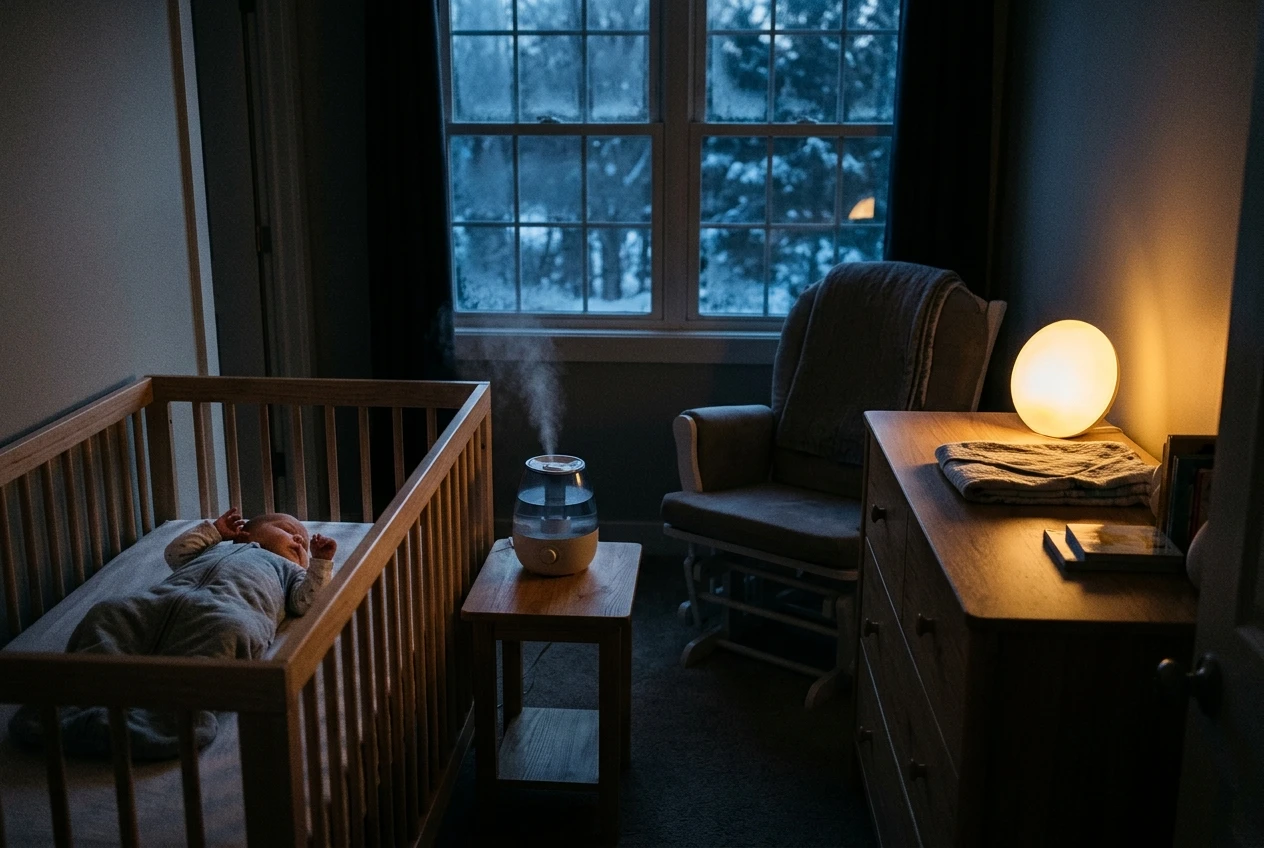
Room temperature matters more in winter than any other season because it’s easier to get wrong in both directions. A room that’s too cold disrupts sleep as reliably as one that’s too warm, and babies cannot regulate their own body temperature as well as adults, so they depend on sleepwear and bedding to do that work. Layering with a sleep sack rated for cooler temperatures, rather than piling on loose blankets, keeps a baby warm without the loose-bedding risk that blankets carry for infants.
Dry air from running a furnace or central heating for weeks at a stretch can irritate a baby’s nasal passages and throat enough to disrupt sleep through congestion or a dry cough, even without an actual cold. A humidifier in the bedroom, kept clean and refilled regularly, addresses this directly; it isn’t a sleep-training fix, it’s a basic environmental correction for an issue heating creates.
A room-by-room temperature and light checklist for each season
Each season asks for a slightly different set of adjustments to the same two variables: light and temperature. A quick reference for what to check in the nursery or bedroom as the seasons turn:
Spring
- Blackout curtains or blinds fully covering the window, including edges, to counter the earlier sunrise
- Room temperature between roughly 68 and 72°F (20 to 22°C), adjusted as heating systems cycle off
- A consistent pre-change and post-change light routine: bright light shortly after wake time, dim light an hour before bed
Summer
- Blackout coverage checked specifically at the exact bedtime hour, since light angle changes through the evening
- A fan or air conditioning to manage heat, with airflow directed away from the crib or bed rather than straight at it
- Lightweight, breathable sleepwear in place of winter sleep sacks
Autumn
- Blackout curtains introduced or reinforced earlier than you’d expect, since the morning light creeping in during this transition is often what pushes wake time earlier
- Gradual adjustment of household heating as evenings cool, watching for a room that’s gotten colder without anyone noticing
- A consistent bedtime routine held steady even as the clock-time of sunset shifts underneath it
Winter
- A sunrise-simulating light or a lamp used consistently at the intended wake time
- A room humidifier, cleaned regularly, to offset dry heated air
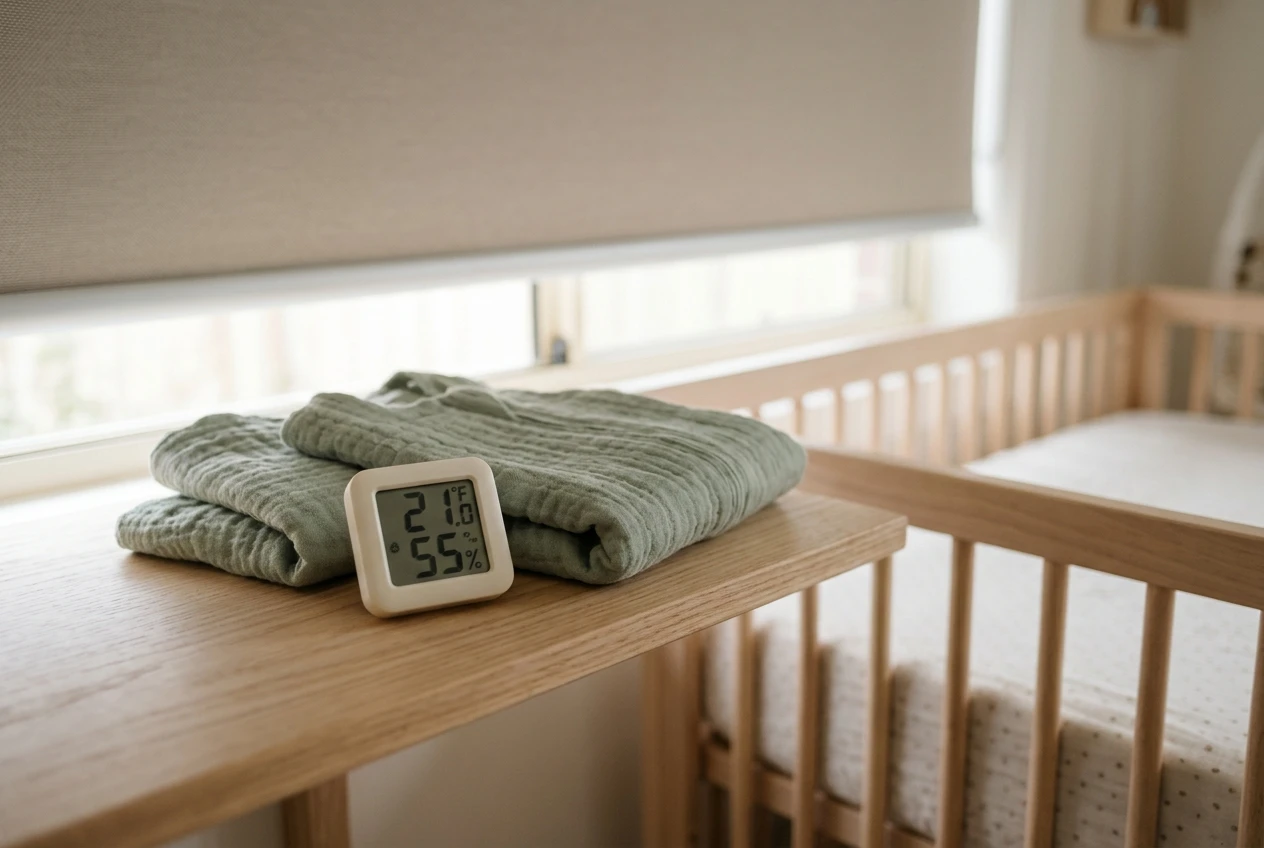
- A rated sleep sack appropriate for the room’s actual temperature, checked with a simple room thermometer rather than guessed by feel, since a room can read as “warm enough” to an adult while still being cool at floor or crib level
In every season, a basic room thermometer is worth more than intuition. What feels like a comfortable temperature to an adult standing in the room isn’t always the same temperature the crib itself sits at, particularly in winter when cold air settles near the floor.
How long a seasonal sleep disruption should realistically last before you worry
Each seasonal disruption has a rough, realistic timeline for resolving on its own once you’ve made the relevant environmental adjustment, and knowing those windows helps you tell the difference between a normal transition and something that needs more attention.
The spring and autumn clock changes typically resolve within three to seven days once a baby’s schedule and the external clock have realigned, assuming the bedroom light is well managed. If a baby is still struggling with timing two weeks after a clock change, the clock change itself usually isn’t still the cause, and it’s worth looking at whether morning or evening light is leaking into the room and undoing the adjustment.
The gradual slides of spring’s earlier sunrise and autumn’s shrinking daylight don’t have a fixed end date in the same way, because the light itself keeps changing for weeks. What you’re looking for isn’t a single resolution point but a new, stable pattern: once a baby has settled into a consistent bedtime and wake time for five to seven days in a row, under the new seasonal light conditions, that’s a sign the adjustment has worked, even if the new schedule looks different from the old one.
Summer’s bright-evening problem and winter’s dry-air or temperature issues are different again, since they’re ongoing environmental conditions rather than a single transition to adapt to. These don’t resolve on a timeline at all; they persist as long as the season does, which is why the fix is a standing environmental change (blackout curtains, a humidifier, consistent sleepwear) rather than a temporary adjustment period you wait out.
If a seasonal change in sleep has lasted more than two to three weeks with no improvement after the relevant light or temperature fix is in place, it’s reasonable to consider whether something other than the season is involved, such as a developmental leap, teething, illness or a nap schedule that’s no longer matched to your baby’s age. Seasons shift a sleep schedule; they don’t usually derail it entirely for a month or more, so a disruption that’s lasting unusually long is worth a closer look rather than more patience.